 中文
 English

IRF7726TRPBFXTMA1 P-Channel MOSFET Replacement: Packing Codes
 Back to previous page

The IRF7726TRPBFXTMA1 is a single P-channel MOSFET in Micro8, rated -30V, 26 mOhm at 10V of drive and 7A at a 25C ambient. It shows up in these positions: reverse-battery protection on a two-cell pack, switching between two supplies, the load switch between a battery and its system, the high-side switch behind a 12V input. All four carry several amps and conduct for long stretches, so the first numbers anyone reads are on-resistance and thermal resistance.
The long part number and IRF7726TRPBF are the same die. The five extra characters are the orderable part number suffix, and they describe packing, reel quantity and a version code. None of them touches an electrical parameter. The manufacturer publishes a translation table for this suffix, and each position can be looked up.
For substitution, VBA8338 is the same package, the same pinout and the same voltage class: -30V, 18 mOhm at 10V, -6.0A at a 25C ambient. This article does not walk the electrical comparison again. It stays on the part number side: why one die carries three numbers, why the silkscreen cannot tell them apart, what reel size means to a placement line, and how the bill of materials should carry the alternatives.
Where the part sits
| Position | How it is connected | Current range |
|---|---|---|
| Reverse-battery protection on a two-cell pack | In the negative return, gate to ground, off when reversed | 3A to 6A |
| Switching between two supplies | Two devices back to back, gates driven by a comparator | 2A to 5A |
| Load switch between battery and system | Source to the battery, gate driven by a key or an MCU | 4A to 7A |
| High-side switch behind a 12V input | In the positive rail, gate pulled low by an enable signal | 3A to 6A |
All four positions want low on-resistance. At 6A the loss through 26 mOhm is 0.94W, which is a 65C rise against a 70C/W junction-to-ambient path; that is right at the edge of what Micro8 can do at 25C, and the same 6A in an 85C enclosure pushes the junction into its limit. This class rarely has thermal headroom to spare, which is why the packing and part number details matter less than the die and more than they appear to.
How the long part number is built
One die, three common spellings, three material states:
| Spelling | Meaning | Status |
|---|---|---|
| IRF7726TR | Tape and reel, plating not stated | Leaded, discontinued |
| IRF7726TRPBF | Tape and reel, lead-free plating | Active |
| IRF7726TRPBFXTMA1 | Five-character orderable part number suffix after PBF | Active, same die |
The five characters read position by position, against the manufacturer's orderable part number table:
| Position | Meaning | Value here | Reading |
|---|---|---|---|
| First | Environmental status: RoHS, halogen, total lead | X | Lead-free, halogen-free |
| Second | Packing type and moisture barrier | T | Tape and reel, non-dry pack |
| Third | Units per reel band | M | 2001 to 5000 |
| Fourth and fifth | Designator | A1 | First version |
The scheme has one advantage: packing information lives inside the part number, so a purchase order cannot drop it. The cost is that one die occupies two or more codes in the system, and every downstream problem starts there.
When the suffix is unfamiliar, two lookups settle it: the manufacturer's orderable part number translation table, which is public and gives each position, and the standard packaging field on a distributor page for that exact code. When the two agree, the codes are the same material.
Silkscreen and reel label
The marking on the package carries the base part number only, the IRF7726 level. Lead-free status, reel quantity and version code are not printed on the part; they live on the reel label.
| Carrier | What it shows | What it does not |
|---|---|---|
| Package marking | Base part number, lot | Lead-free status, reel quantity, version code |
| Reel label | Full orderable part number, quantity, lot, date code | Measured electrical values |
| Incoming paperwork | The code the supplier wrote | Proof that the parts match it |
This changes how incoming inspection has to work. Checking a part number against the silkscreen cannot be done. A leaded and a lead-free device look identical and read identically; the difference is the lead finish, which takes an X-ray fluorescence scan or a supplier declaration of conformity. Reel quantity can only be counted or weighed.
Loose parts, cut tape and reel tails usually arrive without a complete label, so packing details cannot be verified at all. In volume production that material should go back as a lot. It is not a price question, it is the absence of a traceable record.
What reel size does to a placement line
The 2001 to 5000 band lands on 4000 pieces per reel and a 13-inch reel for this part. Three practical consequences follow:
| Item | What happens | What to do |
|---|---|---|
| Feeder space | A 13-inch reel is about 330 mm across, and some older feeders accept 7-inch only | Check the feeder before loading |
| Reel changes | 4000 pieces per reel; a 5000-board run using one part per board needs one change | Put the change point into the run plan |
| Moisture packing | The second suffix position is T, meaning non-dry pack | No bake after opening, but store in a humidity-controlled area |
A non-dry pack corresponds to moisture sensitivity level 1. Parts in this class need no bake after opening and carry no floor-life limit, unlike smaller devices shipped in moisture barrier bags. If a delivery arrives in a dry bag, it does not match the packing this code specifies, and the suffix should be rechecked.
Reel tails have two treatments. A splice keeps the line running, and the splice section trips the empty-pocket sensor on most feeders, so the placement program has to skip that window. The alternative is returning tails to stores as a separate item rather than mixing them into a new reel. Both are safer than loading a tail as if it were a full reel.
Alternatives in the bill of materials
One die under two codes lands in the system in one of two ways, and the difference shows up in stock and on the line:
| Treatment | How it is built | Consequence |
|---|---|---|
| Two independent material numbers | One record per code, no link | Stock splits, alternatives live in memory |
| One primary plus an alternative | One primary record, the other registered against it | Stock merges, purchasing and stores work off the primary |
The second is the better structure. Two independent records split the stock in two, each with its own safety level, so purchasing sees two shortages where the combined quantity is sufficient. Worse, the alternative relationship exists only in a few people's heads and disappears when they leave.
Which code goes into the bill of materials depends on what sits downstream. Automotive, medical and EU-bound projects usually want the full orderable part number, so an audit can match packing and compliance status. Prototype and small builds do fine with the short form. Both point to the same die, and there is no reason to stock against the spelling.
Parameter comparison with VBA8338
The full table sits in the earlier article. Four rows carry the conclusion:
| Parameter | IRF7726TRPBFXTMA1 | VBA8338 | Note |
|---|---|---|---|
| Voltage class | -30V | -30V | Same |
| On-resistance at 10V | 26 mOhm max | 18 mOhm typ | Different columns |
| Gate charge at 10V | 69 nC max | 38 nC max | Same column |
| Steady-state thermal resistance | 70C/W | 95C/W, note c | Replacement is 36 percent worse |
That last row is not a typo. The original datasheet gives one thermal number, 70C/W, and its power derating table is derived from it. The replacement's thermal table gives 40C/W typical and 50C/W maximum at ten seconds, with a note on the same page giving 95C/W as the steady-state ceiling. A battery path conducts continuously, so only the steady-state figure applies, and after substitution the thermal resistance goes up by about a third.
Resistance drops by about 30 percent and thermal resistance rises by 36 percent; the two roughly cancel, so junction temperature at the usual currents stays flat while the loss falls. The IRF7726TR article works that through from 4A to 6A.
Part number and packing fields when replacing
Changing to VBA8338 touches more than the part number:
| Field | Original | After substitution |
|---|---|---|
| Part number | IRF7726TRPBFXTMA1 | VBA8338 |
| Description | P-channel, -30V, 7A, Micro8 | P-channel, -30V, -6.0A, MSOP8 |
| Packing | Tape and reel, 4000 per reel, non-dry | Per supplier label, confirm separately |
| Alternative link | Primary code | Registered as an alternative, original kept |
Packing is the field that gets missed. The replacement's reel may not match the original's, so a line tooled for 13-inch reels needs the new reel size and quantity confirmed before changeover. That does not affect anything electrical; it affects the loading step.
The original code should not be deleted from the bill of materials, only converted into an alternative. Boards already built and spares already shipped are still tracked under it, and deleting the record breaks that trace.
Checks before substitution
| Check | How to verify | If it fails |
|---|---|---|
| Full part number and reel label | Orderable code and quantity on the reel | No written basis for compliance or packing |
| Reel size against the feeder | A 13-inch reel is about 330 mm across | Older feeders will not take it |
| Lead finish | Supplier declaration or fluorescence scan | A leaded lot cannot be proven on the line |
| Pad and pinout | MSOP8, pins 1 to 3 source, 4 gate, 5 to 8 drain | A different pinout cannot be soldered in place |
| Copper area | Size the pad for the continuous loss | Junction runs over its limit |
Pad and pinout match on both parts, so the package drops in. The real work sits in the part number and packing rows, and both are paperwork rather than circuit changes.
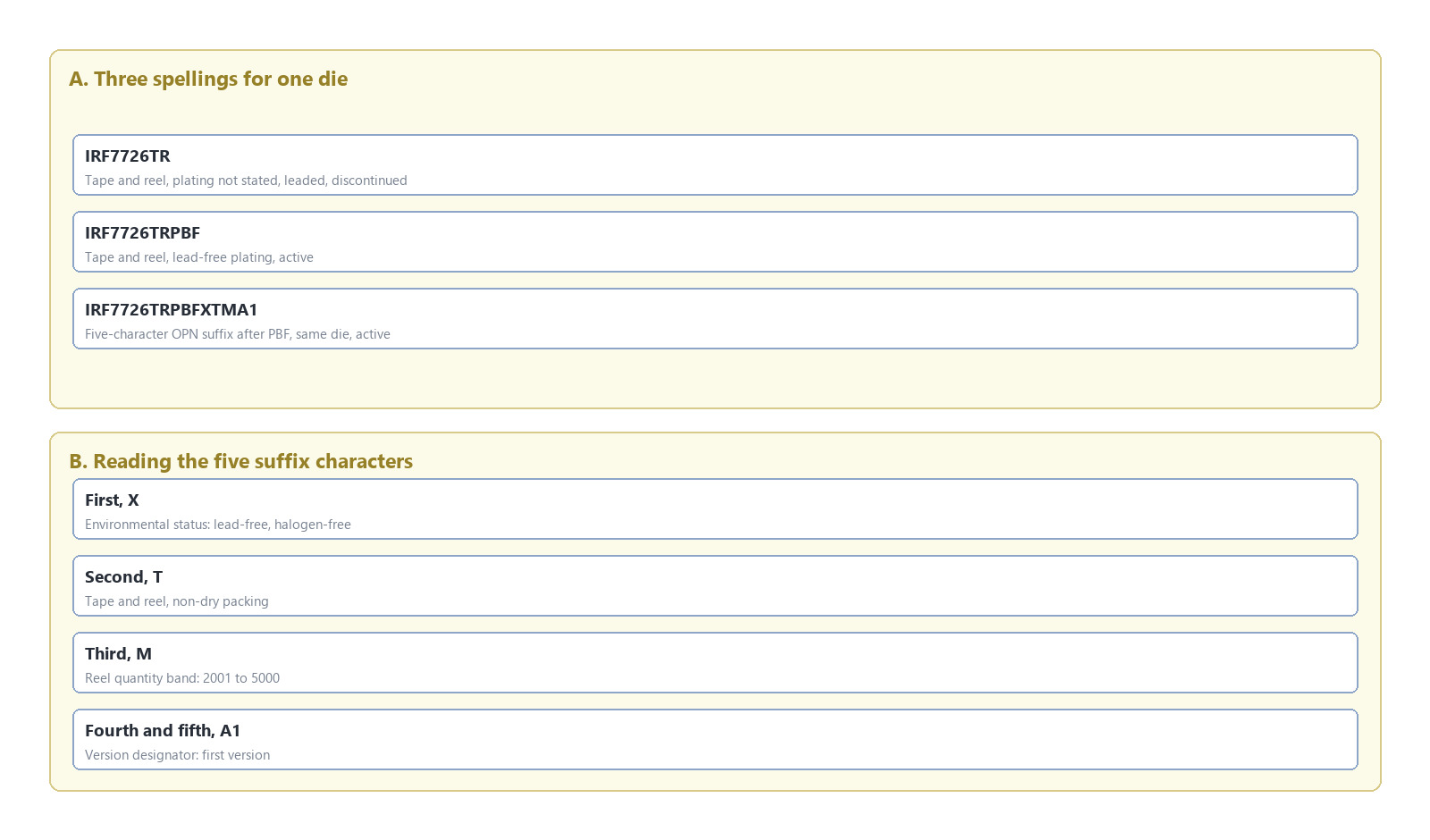
Figure 1. Three spellings for one die, and how the five-character suffix reads. IRF7726TR is the leaded version; IRF7726TRPBF and IRF7726TRPBFXTMA1 are the same lead-free die. The suffix carries environmental status, tape and non-dry packing, a reel quantity band, and a version designator.
FAQ
Are IRF7726TRPBFXTMA1 and IRF7726TRPBF the same part?
Yes. The first carries a five-character orderable part number suffix after the second, describing packing, reel quantity and version code. Die, package and electrical parameters are identical.
Can the five characters be decoded without the manufacturer?
They can, against the published orderable part number table, position by position. Rather than guessing, cross-check that table against the standard packaging field on a distributor page for the same code.
Why does the silkscreen not show lead-free status?
The marking carries the base part number and the lot only. Lead-free status, reel quantity and version code are on the reel label. A leaded and a lead-free device look the same and read the same, and only the lead finish differs.
Does 4000 per reel matter for small purchases?
It does. Small buys are often partial reels or cut tape, and those arrive with incomplete labels, leaving packing details unverifiable. Volume production is better served by full reels with tails managed separately.
Which bill of materials fields change when moving to VBA8338?
Part number, description, packing and the alternative link. Packing is the one that gets missed, since the replacement's reel does not necessarily match the original's, and the reel size has to be confirmed before loading.
What goes wrong with two material numbers for one die?
Stock splits in two and each record carries its own safety level, so purchasing sees two shortages where the combined stock is sufficient. One primary record with the other registered as an alternative keeps purchasing and stores on a single number.
The wider grading of this device class is laid out in the six-part comparison.

Download PDF document
 Download now


