 中文
 English

Scenario Product Guide
Hybrid Road-Air Flying Car Power MOSFET Selection: VBP16R90S / VBE1105 / VBM2157
 Back to previous page
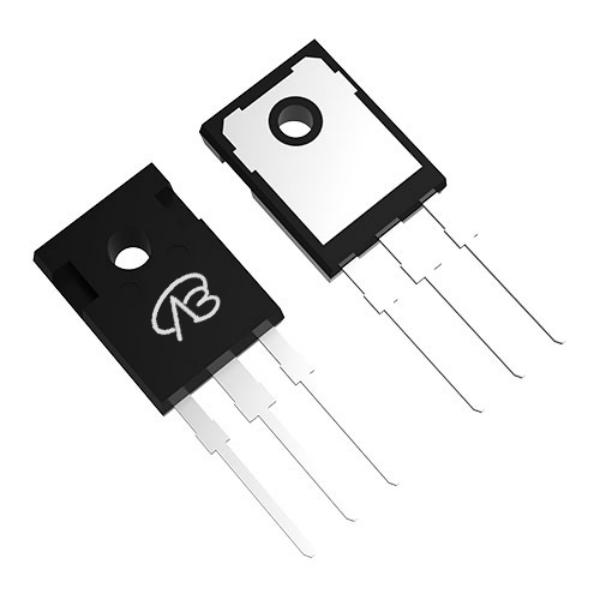
In the context of advancing low-altitude economy and three-dimensional mobility, hybrid road-air integrated flying cars require robust electrical energy conversion systems to ensure efficient propulsion, battery management, and auxiliary control. The performance of these systems hinges on the selection of power MOSFETs, which impact power density, efficiency, thermal handling, and lifecycle reliability. This article, targeting the demanding application scenario of flying cars—with stringent requirements for power rating, dynamic response, safety, and environmental adaptability—conducts an in-depth analysis of MOSFET selection for key power nodes, providing an optimized device recommendation scheme.
Key Takeaways
• Three power nodes: high-voltage propulsion and DC-DC (VBP16R90S, 600V/90A), low-voltage high-current battery management (VBE1105, 100V/100A), and auxiliary intelligent distribution (VBM2157N, -150V P-MOS).
• Selection rules: operate high-voltage MOSFETs at ≤70–80% of rated voltage, use isolated gate drivers with negative turn-off for the 600V stage, and keep creepage/clearance margins for high-altitude operation.
• Roadmap: SiC MOSFETs above 1200V for propulsion inverters, integrated sensing switches for health monitoring, and GaN devices in intermediate converters for MHz-range switching.
Recommended Power MOSFETs at a Glance
Device | Type | VDS | Continuous Current | Rds(on) | Package | Role in This Solution |
VBP16R90S | N-MOS (SJ_Multi-EPI) | 600V | 90A | 24mΩ @10V | TO-247 | High-voltage DC-DC / motor drive main switch |
VBE1105 | N-MOS | 100V | 100A | 5mΩ @10V | TO-252 | Low-voltage high-current battery management switch |
VBM2157N | P-MOS | -150V | -40A | 65mΩ @10V | TO-220 | Auxiliary system high-side distribution switch |
Detailed MOSFET Selection Analysis
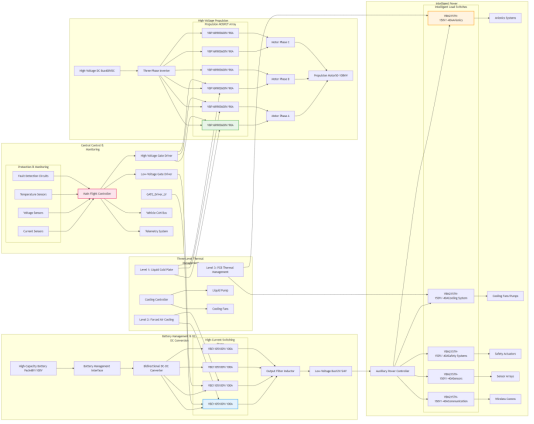
Figure 1: Overall power topology of the hybrid road-air flying car — propulsion, energy storage and auxiliary control power nodes
1. VBP16R90S (N-MOS, 600V, 90A, TO-247)
Role: Main switch for high-voltage DC-DC conversion or motor drive stages in the propulsion system.
- Voltage Stress & Reliability: In flying car powertrains, bus voltages can reach 400V or higher. The 600V-rated VBP16R90S offers a safety margin against voltage spikes and grid fluctuations. Its SJ_Multi-EPI technology ensures stable blocking capability and low switching losses, critical for handling high-frequency transitions in inverter or converter topologies, ensuring reliability during aerial maneuvers and variable loads.
- System Integration & Topology Suitability: With a low Rds(on) of 24mΩ at 10V and 90A continuous current, it suits high-power phases (e.g., 50kW-100kW) in multi-phase interleaved designs. The TO-247 package facilitates parallelization for power scaling and centralized heat dissipation, aligning with the compact, high-density requirements of flying car power electronics.
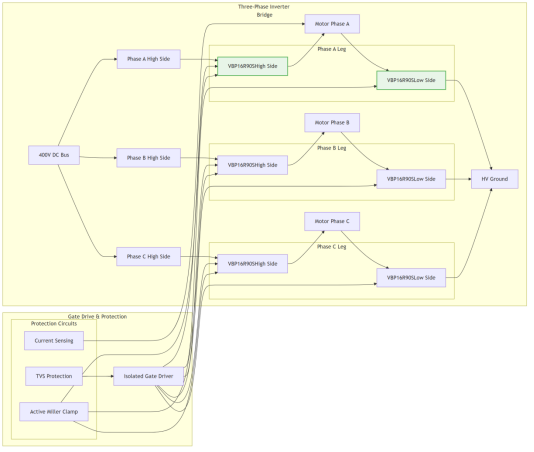
Figure 2: High-voltage propulsion stage — VBP16R90S (600V/90A, TO-247) main switch for DC-DC conversion and motor drive
2. VBE1105 (N-MOS, 100V, 100A, TO-252)
Role: Main switch for low-voltage, high-current battery management or bidirectional DC-DC conversion in the energy storage system.
- Ultimate Efficiency Power Transmission Core: Flying car batteries operate at low voltages (e.g., 48V or 100V) with high current demands. The 100V-rated VBE1105 provides ample margin, and its trench technology yields an ultra-low Rds(on) of 5mΩ at 10V. Combined with 100A continuous current, it minimizes conduction losses in synchronous rectification or motor drive circuits, enhancing overall system efficiency.
- Power Density & Thermal Challenge: The TO-252 package allows compact mounting on liquid-cooled or forced air-cooled heat sinks, ideal for space-constrained flying car modules. In soft-switching topologies like LLC, its low on-resistance reduces thermal stress, supporting high power density and extended battery life.
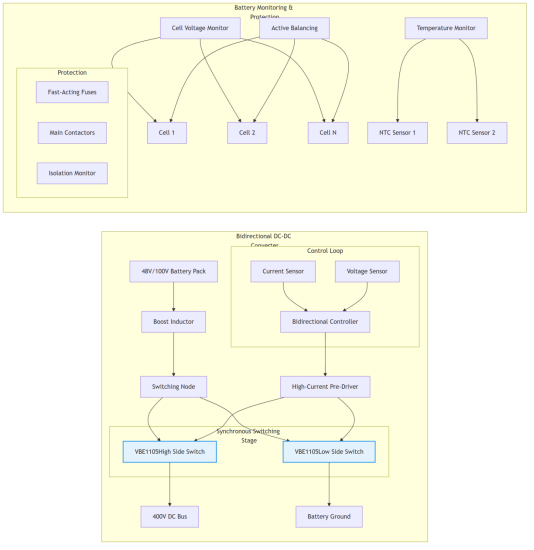
Figure 3: Battery management and bidirectional DC-DC — VBE1105 (100V/100A, TO-252) in the low-voltage high-current path
3. VBM2157N (P-MOS, -150V, -40A, TO-220)
Role: Intelligent power distribution for auxiliary systems, safety interlocks, or high-side switching in control units.
- High-Integration Intelligent Control: This P-channel MOSFET in a TO-220 package offers a -150V rating, suitable for 12V/24V or higher auxiliary buses in flying cars. It can serve as a high-side switch for critical loads like avionics, cooling fans, or safety actuators, enabling modular control based on fault signals or temperature cues, saving space in control boards.
- Low-Power Management & High Reliability: With a turn-on threshold of -2V and Rds(on) as low as 65mΩ at 10V, it allows direct drive by low-voltage MCUs, simplifying control paths. Its single-P design supports independent load switching, enabling fault isolation and enhancing system availability during flight operations.
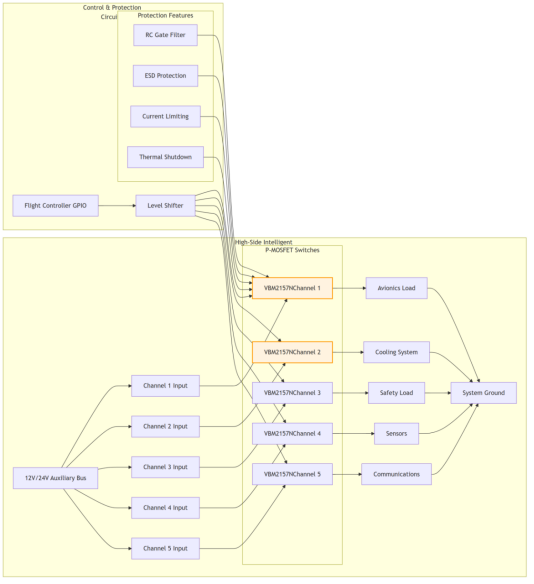
Figure 4: Auxiliary system intelligent distribution — VBM2157N P-MOS (-150V/-40A) high-side switching for avionics and safety actuators
System-Level Design and Application Recommendations
Drive Circuit Design Key Points:
- High-Side Drive (VBP16R90S): Pair with an isolated gate driver. Implement negative voltage turn-off or active Miller clamping to mitigate Miller capacitance effects, ensuring noise immunity in high-voltage switching environments.
- High-Current Switch Drive (VBE1105): Use a pre-driver with high current capability for fast gate charge/discharge, minimizing switching losses. Layout must reduce power loop parasitic inductance to prevent voltage spikes.
- Intelligent Distribution Switch (VBM2157N): Can be driven directly by MCU via level shifting. Add RC filtering and ESD protection at the gate to enhance noise immunity in electromagnetic-intensive flight systems.
Thermal Management and EMC Design:
- Tiered Thermal Design: VBP16R90S requires mounting on a liquid cold plate or large heatsink; VBE1105 needs tight thermal coupling to a cold plate via pads; VBM2157N can dissipate heat through PCB copper pour or a small heatsink.
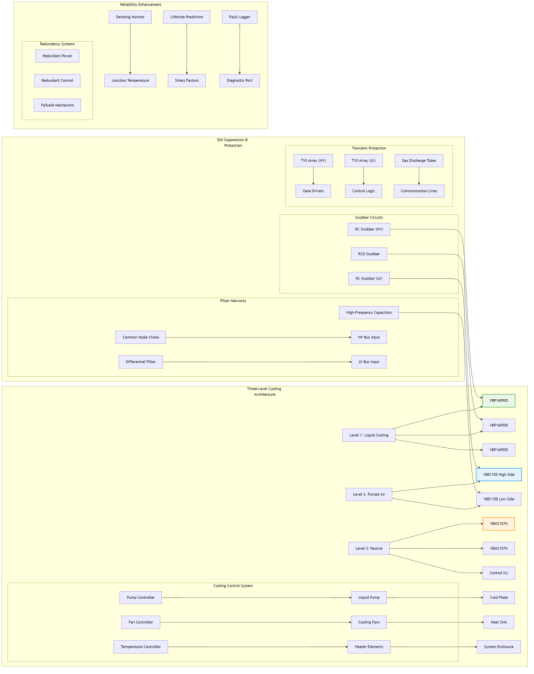
Figure 5: Tiered thermal management and EMC layout — cold plate, PCB copper and snubber placement
Conclusion
In high-power, high-reliability electrical systems for hybrid road-air integrated flying cars, MOSFET selection is key to achieving efficient propulsion, intelligent energy management, and all-weather operation. The three-tier MOSFET scheme recommended here embodies high power density, reliability, and intelligence.
Frequently Asked Questions (FAQ)
Q: Which device is recommended for the high-voltage propulsion stage?
A: VBP16R90S (N-MOS, 600V, 90A, TO-247) — SJ_Multi-EPI technology with a 24mΩ Rds(on) at 10V suits 50–100kW high-power phases in multi-phase interleaved designs and allows parallelisation for power scaling.
Q: Which device handles low-voltage high-current battery management?
A: VBE1105 (N-MOS, 100V, 100A, TO-252) — an ultra-low 5mΩ Rds(on) at 10V with 100A continuous current minimises conduction loss in synchronous rectification and bidirectional DC-DC conversion.
Q: Which device performs auxiliary intelligent power distribution?
A: VBM2157N (P-MOS, -150V, -40A, TO-220) — a -2V turn-on threshold allows direct low-voltage MCU drive, making it a high-side switch for avionics, cooling fans and safety actuators with fault isolation.

Download PDF document
 Download now:VBP16R90S


Request Free Samples
*To request free samples, please complete and submit the following information.
Our team will review your application within 24 hours and arrange shipment upon approval. Thank you!