 中文
中文 English
Scenario Product Guide
Last updated:
2026 Aerospace-Grade Power MOSFET Selection & Model Recs for eVTOL
 Back to previous page
The Era of Challenges in eVTOL Power Semiconductor Selection in 2026
In 2026, eVTOL (Electric Vertical Take-Off and Landing) aircraft are accelerating their transition from technology verification to large-scale commercial operation. Multiple cities worldwide have launched low-altitude economic pilot programs, airworthiness certification standards are being gradually implemented, and aircraft manufacturers are imposing unprecedentedly stringent requirements on the power density, reliability, and cost of power systems. Power semiconductors, as the "heart" of the eVTOL electrical system, directly determine the aircraft's endurance, safety redundancy, and life-cycle economics through their selection and engineering practices.
Against this backdrop, traditional industrial or automotive-grade MOSFETs are no longer sufficient to meet the demands of aerospace applications for extreme derating, thermal management, radiation resistance, and fault tolerance. Wide-bandgap devices such as silicon carbide (SiC) and gallium nitride (GaN) are rapidly penetrating the main propulsion and high-voltage power distribution fields, while smart power distribution and redundant architectures are placing higher demands on the integration and response speed of low-voltage MOSFETs. Based on the latest device technology advancements and airworthiness requirements up to 2026, this article systematically reviews the key points for MOSFET selection in the three core scenarios of eVTOL (main propulsion, high-voltage DC-DC, and low-voltage avionics and smart power distribution), and provides engineers with a forward-looking and practical engineering reference by combining typical models and topology designs.
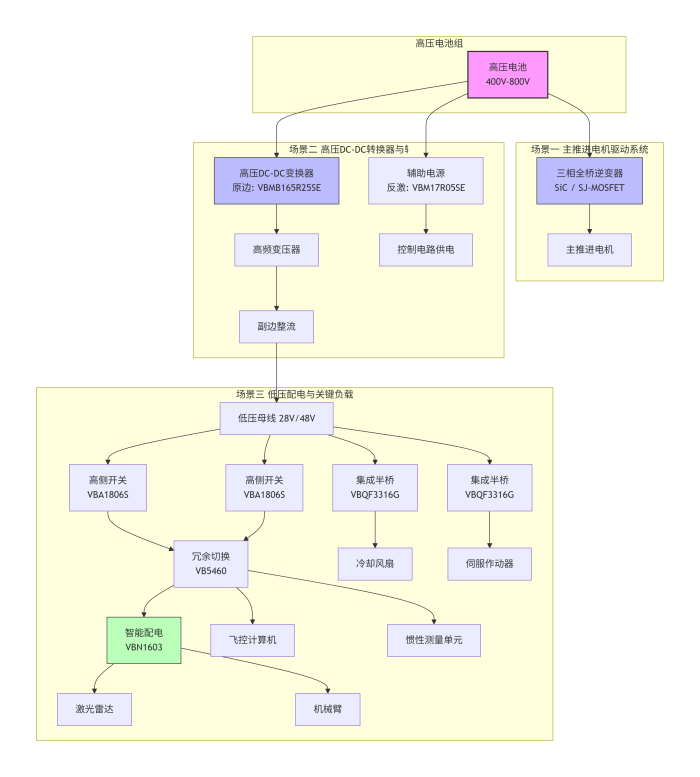
The requirements for power MOSFETs in eVTOL (electric vertical takeoff and landing aircraft) are far higher than those for industrial or automotive applications, with the core requirements being aerospace-grade reliability, extreme power density, and adaptability to extreme environments. Selection must be tailored to specific application scenarios (main propulsion, high-voltage power supply, low-voltage power distribution).
The following is an analysis and model recommendation for MOSFET selection in the three core application scenarios of eVTOL:
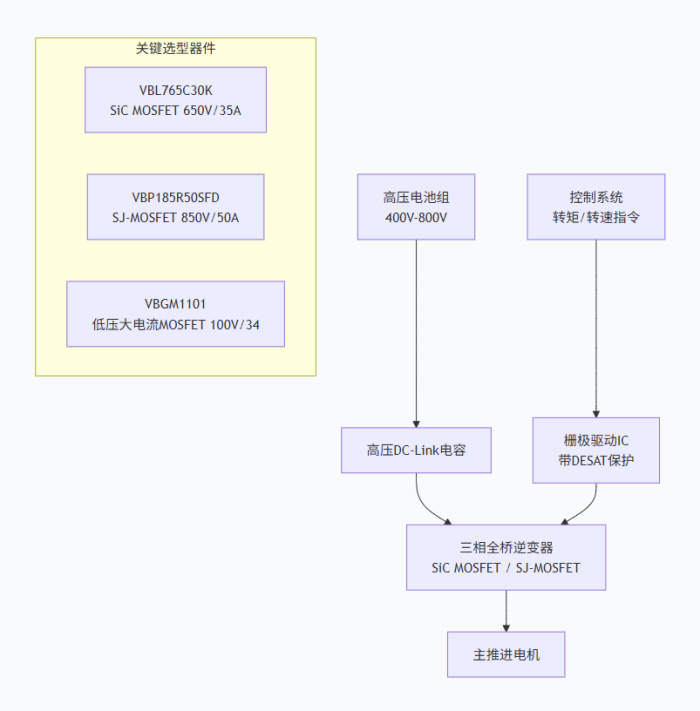
Scenario 1: High-Voltage Main Propulsion Motor Drive System (Power Core)
This is the maximum power part of the eVTOL, directly determining flight performance. The bus voltage is typically 400V-800V (or even higher), with power ratings exceeding 100kW. The core selection criteria are high withstand voltage, extremely low conduction loss, and high switching frequency.
Selection Requirements | Recommended Models and Technical Parameters | Application Analysis and Design Key Points |
High withstand voltage margin: 800V systems require components with a withstand voltage of ≥850V to cope with voltage spikes generated by high-speed motor switching and surges induced by lightning strikes | VBL765C30K (SiC MOSFET) | SiC advantages: high switching frequency, which can significantly reduce the size of filter inductors/transformers; good high-temperature characteristics, suitable for continuous high-power output |
Extremely low loss: This requires both low on-resistance (conduction loss) and low gate charge (switching loss) to improve efficiency and power density | VBP185R50SFD (SJ-MOSFET) | System value: Enables precise motor torque control and improves efficiency. Requires the use of an isolated driver IC (with DESAT protection). When multiple transistors are connected in parallel, the PCB layout needs to be optimized to minimize parasitic inductance in the power loop. |
Packaging and Thermal Management: Low thermal resistance packages such as TO247 and TO220 are preferred for easy installation of heat sinks or cold plates. | VBGM1101 | Application scenarios: Suitable for high-power motor drives on 48V low-voltage buses. The TO220 package enables extremely high power density, but requires multi-layer PCB with thick copper and thermal vias for heat dissipation. |
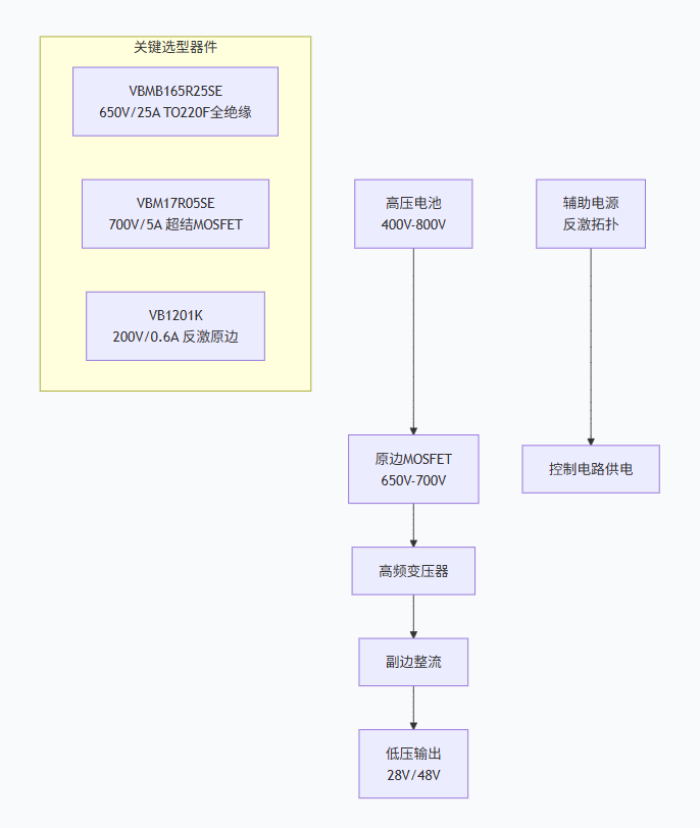
Scenario 2: High-Voltage DC-DC Converter and Power Distribution System (Energy Hub)
This system converts high-voltage batteries (400V-800V) to low-voltage (28V/48V) power avionics, flight control, and other equipment. Selection should focus on isolation requirements, a wide input voltage range, and conversion efficiency.
Scenario 3: Low-Voltage Avionics, Flight Control, and Intelligent Power Distribution Systems (Safety Cornerstone)
This system provides power and management for critical loads such as flight control computers, sensors, and communication and navigation equipment. The core selection criteria are high reliability, rapid fault isolation, and low on-state voltage drop
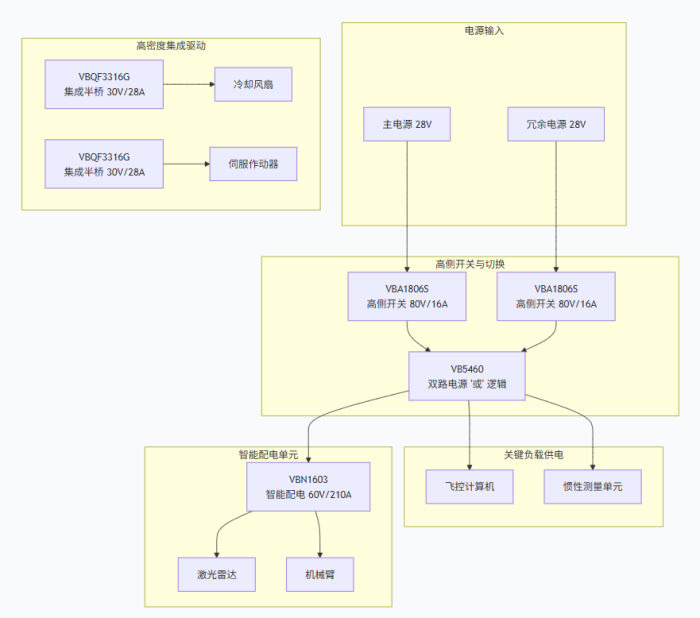
Selection Requirements | Recommended Models and Technical Parameters | Application Analysis and Design Key Points |
Low on-resistance: As a high-side or low-side switch, it is necessary to minimize its own losses and not generate additional heat | VBA1806S | System value: Enables independent power supply and isolation for redundant avionics channels. Extremely low on-state voltage drop generates virtually no heat, improving overall system reliabilit |
Redundancy and Switching: Seamless switching between dual power supplies is required to ensure uninterrupted system operation in the event of a single power supply failure. | VB5460 | Design considerations: This design utilizes the "OR" logic for power supply switching in critical equipment such as flight controllers and IMUs. The control logic should be managed by an independent monitoring unit to achieve nanosecond-level fault detection and switching |
Intelligent power distribution: providing independent protection and monitoring for high-current equipment (such as lidar and robotic arms) | VBN1603 | Scenario Adaptability: Ultra-low Rds(on) ensures extremely low losses on a current distribution path of hundreds of amperes. Requires a current sampling circuit to achieve hardware-level fast overcurrent protection |
High-density integration: Achieving multi-channel control within a limited space, such as fan and servo motor drives | VBQF3316G | System advantages: The integrated half-bridge structure saves PCB area, simplifies the drive circuit, and is suitable for flight control servo actuators or cooling fan drives, achieving precise PWM control |
General principles for eVTOL MOSFET selection
Extreme derating design: Aerospace-grade applications require stringent derating. It is generally recommended that voltage stress not exceed 80% of the rated value and continuous operating current not exceed 50%-60% of the nominal value to ensure long-term reliability under extreme conditions such as high temperature and high vibration.
Packaging and heat dissipation synergy: Small packages such as DFN and SOT are used to increase power density, but they must be used in conjunction with thick copper on the PCB, heat dissipation vias, or even microchannel liquid cooling for heat dissipation; while large packages such as TO247 are suitable for efficient heat dissipation through cold plates.
Drive and protection: A dedicated gate driver IC must be used, which has undervoltage lockout, overcurrent protection (DESAT) and soft shutdown functions to prevent MOSFET damage under abnormal operating conditions.
Future trends: In pursuit of ultimate power density and efficiency, main propulsion systems are gradually transitioning to silicon carbide (SiC) MOSFETs; while in auxiliary power supplies or low-voltage high-power scenarios, gallium nitride (GaN) HEMTs will be increasingly widely used.
In conclusion, MOSFET selection for eVTOL is a systematic project. Engineers must find the optimal balance between electrical performance, thermal performance, and reliability based on the specific system voltage platform, power level, heat dissipation conditions, and safety redundancy architecture.

Download PDF document
 Download now:VB1201K


Request Free Samples
*To request free samples, please complete and submit the following information.
Our team will review your application within 24 hours and arrange shipment upon approval. Thank you!