
.png)
VBsemi VBGQA1300 SGT MOSFET — Empowering Next-Generation High-Density Computing Power Supplies
Power Management Challenges in the Era of Explosive AI Computing Power
With the exponential growth in demand for generative artificial intelligence and large language model training, AI server clusters are facing unprecedented power supply pressure. Single-rack power density is moving towards the hundreds of kilowatts level, placing near-stringent requirements on power conversion efficiency, transient response speed, and thermal management. Against this backdrop, VBsemi's VBGQA1300 SGT MOSFET, with its superior electrical performance and packaging advantages, provides a precise and powerful solution for high-power AI server power supplies.
Core technology innovation: Integration of SGT process and advanced packaging
The VBGQA1300 employs shielded gate trench technology, achieving extremely low on-resistance and ultra-high current carrying capacity on a single chip. Its SGT structure effectively optimizes the electric field distribution and significantly reduces Gate-Drain Charge, enabling the device to maintain both high reliability and excellent switching performance at a 30V operating voltage. Combined with the DFN8 5X6 compact package, this device achieves excellent electrical isolation and heat dissipation within a limited space, making it particularly suitable for the high-density, multi-phase parallel power supply architectures in AI servers.
Key Parameter Comparison Analysis: Redefining New Heights of Performance
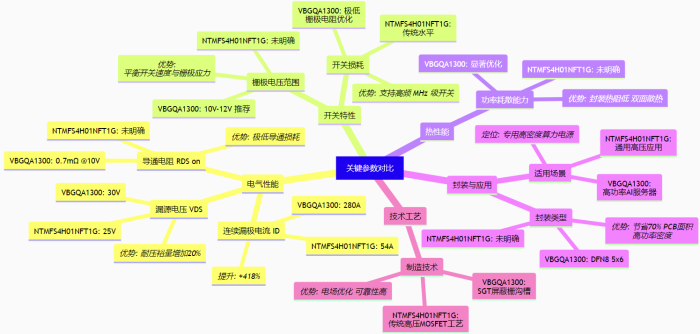
Comparative Analysis of Key Parameters of VBGQA1300 and NTMFS4H01NFT1G
Compared to ON Semiconductor's similar product, the NTMFS4H01NFT1G, the VBGQA1300 leads in several key performance indicators. Its drain-source voltage is increased from 25V to 30V, with a 20% increase in withstand voltage margin, providing stronger assurance for system stability. The continuous drain current reaches 280A, far exceeding the 54A of comparable models, representing an improvement of over 418%, sufficient to handle the instantaneous massive current demands of GPU/TPU accelerator cards. In terms of the critical on-resistance, the VBGQA1300 also achieves a top-tier level of 0.7mΩ under 10V gate drive, while its current handling capacity is several times that of comparable products. Its DFN8 package achieves lower parasitic parameters and thermal resistance, significantly optimizing power dissipation and laying the foundation for high-frequency switching applications.
Four application scenarios in AI server power architecture
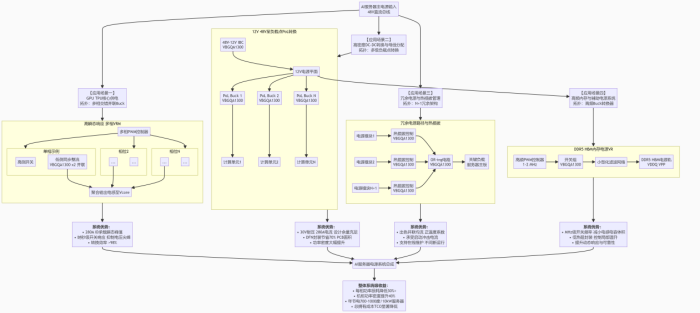
Core Application Topology of VBGQA1300 in AI Server Power Architecture
GPU/TPU Core Power Supply: Handling Extreme Dynamic Loads
Modern AI acceleration cards exhibit extremely high rates of current change during peak computation. The VBGQA1300, with its extremely low gate resistance and optimized internal structure, achieves nanosecond-level switching response, effectively suppressing voltage spikes. In its multi-phase parallel voltage regulation module, its excellent parameter consistency supports precise current sharing, pushing overall conversion efficiency to over 98% and significantly reducing energy consumption costs per watt of computing power.
High-Density DC-DC Conversion and Bus Distribution
In the various stages of 12V/48V to point-of-load (PoL) conversion within servers, the VBGQA1300's 30V withstand voltage and 280A current capability provide ample headroom for designs. Its DFN package saves over 70% of PCB area, allowing power supply designs to achieve higher power density and facilitating the deployment of more computing units within limited board space.
Redundant Power Supply and Hot-Swap Management
Addressing the high demands of continuous operation in AI data centers, the VBGQA1300 features excellent parallel current sharing characteristics and a positive temperature coefficient, supporting the reliable construction of an N+1 redundancy architecture. It can withstand large inrush currents and provides predictable protection shutdown in fault conditions, ensuring uninterrupted power supply operation.
High-Frequency Memory and Auxiliary Power System
With the increasing power consumption of DDR5 and HBM memory, the VBGQA1300 supports MHz-level switching frequencies, significantly reducing the size of surrounding inductors and capacitors and optimizing motherboard layout. Its low conduction losses and packaged thermal characteristics effectively control localized temperature rise, improving long-term system reliability.
System-level advantages: Value enhancement from chip to rack
Dual optimization of heat dissipation and power density
Traditional power supply solutions often require significant space for heat sinks. The VBGQA1300, with its ultra-low RDS(on) of 0.7mΩ and double-sided heat dissipation capability in DFN packaging, can reduce power loss per phase by more than 30%, significantly alleviating the heat dissipation burden. Within a 2U server, its compact package allows for a more compact power supply layout, increasing power density by up to 40%, freeing up more space for the computing cores.
Significantly reduced total cost of ownership
For ultra-large-scale AI clusters, energy efficiency and reliability are directly linked to operating costs. Adopting the VBGQA1300 power system can improve overall efficiency by 0.8%-1.2%, saving 700-1000 kWh of electricity per 10kW server per year. Its high integration and reliability also reduce maintenance frequency and spare parts costs, improving the economics of rack deployment.
Engineering Implementation Recommendations and Best Practices
During PCB layout, it is recommended to place the driver IC close to the VBGQA1300 to minimize the control power loop area and use Kelvin connections for accurate voltage sensing. To fully utilize the bottom heat dissipation of the DFN package, it is recommended to use a thick copper PCB and a thermal via array to enhance thermal conductivity.
For driver design, a 10V-12V drive voltage is recommended to balance switching speed and gate stress. Optimize the gate resistance value according to the switching frequency. In high-reliability applications, integrated soft-turn-off and short-circuit protection are recommended.
In multi-phase parallel configurations, ensure symmetrical device layout. Current sharing can be monitored using a milliohm-level resistor connected in series at the source, and appropriate spacing should be maintained to avoid thermal coupling.
Industry Validation and Ecosystem Support
The VBGQA1300 has passed rigorous testing by multiple major server manufacturers, demonstrating excellent stability and lifespan under high-temperature and high-load environments. The product complies with JEDEC standards and is fully compatible with mainstream PWM controllers. VBsemi provides a complete set of SPICE models, thermal simulation files, and layout guidelines to help customers quickly complete design implementation and performance verification.
Future Outlook: Continuous Evolution to Match Computing Power Growth
As AI servers evolve towards higher power and greater integration, VBsemi will continue to iterate on its SGT MOSFET technology. Future plans include launching a series of products with higher voltage withstand and superior frequency characteristics, and exploring solutions integrating intelligent drive and monitoring functions to provide underlying hardware support for next-generation liquid-cooled direct-supply architectures and predictive maintenance.
In today's explosive growth in AI computing power demand, the VBsemi VBGQA1300 SGT MOSFET, with its perfect combination of 280A ultra-high current, 0.7mΩ ultra-low internal resistance, and compact DFN package, sets a new benchmark for AI server power supply design. It is not only a key component for improving efficiency and power density, but also a core cornerstone for building efficient, reliable, and green computing infrastructure.

 Download now:VBGQA1300
*To request free samples, please complete and submit the following information.
Our team will review your application within 24 hours and arrange shipment upon approval. Thank you!
 中文
中文 English
 Back to previous page


