
.png)
Foreword: From Humanoid Robots to the Era of "Manned Mechs"
In 2026, the robotics industry is evolving from traditional industrial robotic arms and humanoid robots towards "human-carrying transformable mecha robots." With the development of high-power-density electric drive systems, AI real-time motion control, lightweight composite materials, and high-energy-density battery platforms, a new generation of mecha robots with human-carrying capabilities, dynamic transformation capabilities, and adaptability to complex terrains has gradually moved from the proof-of-concept stage to the engineering stage.
The biggest difference between manned mecha platforms and traditional robots is that:
Significantly increased power ratings
Higher joint impact loads
More complex dynamic stability control
Power systems are trending towards "mobile energy storage platformization"
High-frequency AI computing and real-time control power consumption is surging
Safety redundancy requirements are approaching those of new energy vehicles and avionics
In the entire platform, MOSFETs are no longer just "switching devices," but rather core foundational components for the entire robotic powertrain, power supply system,
thermal management system, and safety control system.
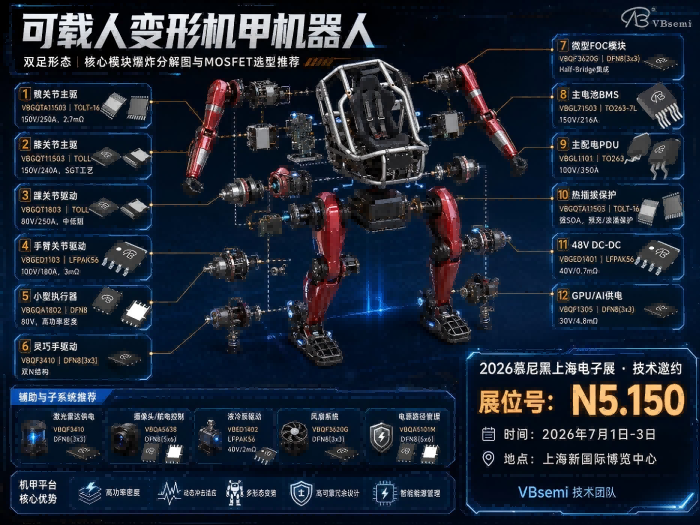
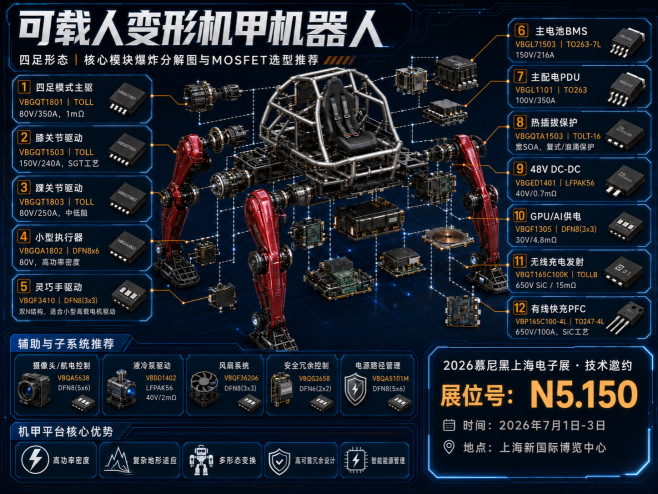
Quick Reference Table for VBsemi MOSFET Selection for Manned Transforming Mech Robots
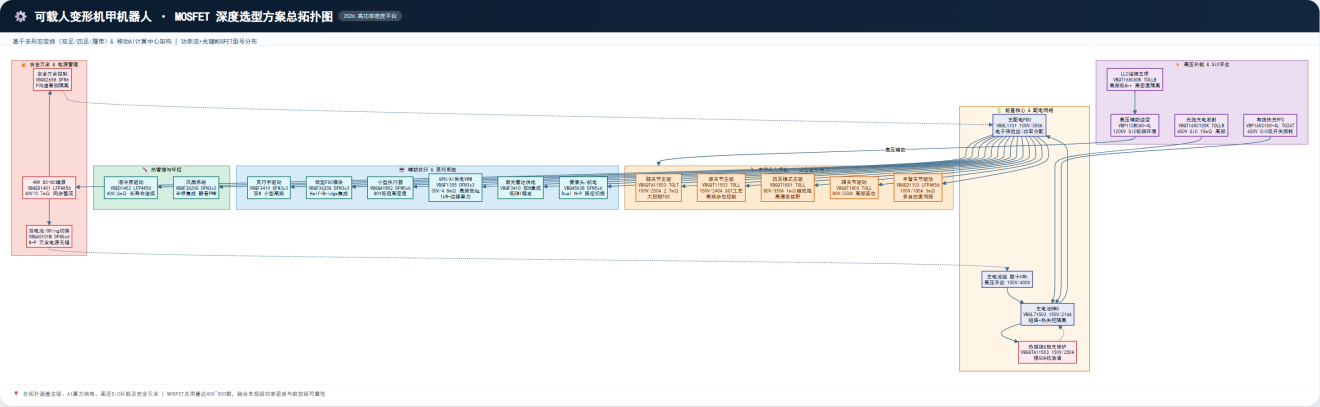
System Modules | Core Functions | Recommended Models | Packaging | Key Robot-Level Adaptation Parameters | Estimated Quantity |
Hip Joint Main Drive | High-torque FOC drive | VBGQTA11503 | TOLT-16 | 150V/250A, ultra-low resistance 2.7mΩ, suitable for heavy-duty dynamic shock | 24~48 |
Knee Joint Main Drive | High-dynamic gait control | VBGQT11503 | TOLL | 150V/240A, SGT, low parasitics, suitable for high-frequency servo drives | 24~48 |
Quadruped Mode Main Drive | Quadrupedal stable motion control | VBGQT1801 | TOLL | 80V/350A, 1mΩ ultra-low resistance, suitable for high peak burst currents | 24~36 |
Ankle Joint Drive | High-frequency attitude adjustment | VBGQT1803 | TOLL | 80V/250A, Low and medium resistance balance efficiency and cost | 12~24 |
Arm Joint Drive | Multi-degree-of-freedom servo control | VBGED1103 | LFPAK56 | 100V/180A, 3mΩ,Suitable for medium-power robot joints | 24~48 |
Miniature Actuator | Dexterous motion control | VBGQA1802 | DFN8(5x6) | 80V low impedance, high power density suitable for small FOC | 20~60 |
Dexterous Hand Drive | Miniature servo control | VBQF3410 | DFN8(3x3) | Dual N structure, suitable for small high-frequency motor drives | 20~80 |
Miniature FOC Module | Finger/Gimbal/Fan control | VBQF3620G | DFN8(3x3) | Half-Bridge integration, reducing drive complexity | 20~100 |
Main Battery BMS | Battery protection switch | VBGL71503 | TO263-7L | 150V/216A, high reliability suitable for robot battery platforms | 6~12 |
Main Power Distribution PDU | Bus power distribution | VBGL1101 | TO263 | 100V/350A, high current suitable for electronic fuses | 6~16 |
Hot-Swap Protection | Pre-charge/surge protection | VBGQTA11503 | TOLT-16 | Strong SOA capability to handle robot regeneration peaks | 4~12 |
48V DC-DC | Auxiliary energy conversion | VBGED1401 | LFPAK56 | 40V/0.7mΩ, high-frequency synchronous rectification optimized | 20~60 |
GPU/AI Power Supply
| High Computing Power VRM | VBQF1305 | DFN8(3x3) | 30V/4.8mΩ, low parasitics suitable for high-frequency Buck | 30~120 |
LiDAR Power Supply | Stable power supply for sensors | VBQF3410 | DFN8(3x3) | Dual MOS integration, reducing EMI and area | 8~20 |
Camera/Avionics Control | Low-voltage logic power supply | VBQA5638 | DFN8(5x6) | Dual N+P structure, suitable for power path switching | 10~30 |
Liquid Cooling Pump Drive | Thermal management cycle system | VBED1402 | LFPAK56 | 40V/2mΩ, long-lifespan continuous-operation optimized | 4~12 |
Fan System | Cooling duct control | VBQF3620G | DFN8(3x3) | Half-bridge integration, suitable for silent PWM drives | 8~24 |
Wireless Charging Transmitter | High-frequency resonant drive | VBQT165C100K | TOLLB | 650V SiC/15mΩ, suitable for high-frequency high-power wireless charging | 12~36 |
Wired Fast Charging PFC | AC-DC power factor correction | VBP165C100-4L | TO247-4L | 650V/100A, SiC process reduces switching losses | 4~12 |
LLC Resonant Main Bridge | High-frequency isolation conversion | VBQT165C60K | TOLLB | High-frequency low Qrr optimization, suitable for high-density LLC | 8~24 |
High Voltage Auxiliary Inverter | Special High-Voltage Electric Drive | VBP112MC40-4L | TO247-4L | 1200V SiC platform, adapted to extreme high-voltage environments | 2~6 |
Safety Redundancy Control | Logic isolation/protection | VBQG2658 | DFN6(2x2) | P-channel structure, suitable for high-side fault isolation | 10~40 |
Power Path Management | Dual battery switching/ORing | VBQA5101M | DFN8(5x6) | Dual N+P structure, suitable for robot redundant power supply switching | 6~20 |
I. Characteristics of the Power System of Manned Transformable Mecha
1.1 Power Density Far Exceeds Traditional Humanoid Robots
Ordinary bipedal robots typically operate on a 24V~48V platform, with peak power in the kilowatt range. However, humanoid mecha platforms, due to the need to support
human weight, armor structures, and complex motion mechanisms, have core drive system power requirements that include:
Continuous Power: 20kW~80kW
Peak Power: Over 100kW
Transient Burst Current: Hundreds of Ampers
This means that the main drive MOSFET must simultaneously meet the following requirements:
Ultra-low on-resistance
Extremely strong SOA capability
High pulse tolerance
High-frequency FOC compatibility
Extremely low parasitic parameters
Traditional consumer-grade MOSFETs can no longer meet the demands, and robot main drives have begun moving toward automotive-grade power devices used in new energy vehicles
1.2 The Dynamic Impact of Multimorphic Transformation
Manned transforming mechs typically possess:
Bipedal mode
Quadrupedal mode
Track-assisted mode
High-mobility jump mode
Heavy-load stability mode
Switching between different modes results in significant transient impacts on joint currents. For example:
Large inertia backflow current occurs in hip joint actuation
High-frequency torque pulses are generated in the knee joint
Periodic large current bursts occur in quadrupedal mode
Extremely strong regenerative spikes are generated upon landing after a jump
Therefore, in addition to low impedance, MOSFETs are more importantly characterized by:
Avalanche capability
Thermal cycle life
High-temperature stability
High-frequency EMI control capability
II. MOSFET Selection Guide for Main Drive System
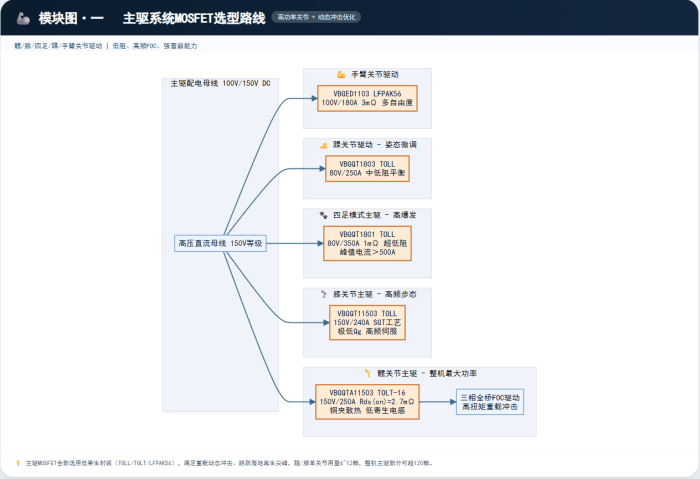
2.1 Hip Joint Main Drive: The Platform's Core Power Semiconductor Module
The hip joint is one of the most powerful actuators in the entire machine.
Its characteristics include:
High torque output
High inertia load
Long-term continuous operation
Dynamic center of gravity balance control
Recommended model:
VBGQTA11503, TOLT-16 package, 150V/250A, 2.7mΩ ultra-low on-resistance
Compared to traditional TO packages, the TOLT package offers:
Lower parasitic inductance
Stronger heat dissipation due to its copper clip structure
Better high-frequency stability
More suitable for high-frequency FOC servo drives
In mecha platforms, the hip joint typically uses a three-phase full-bridge structure.
The number of MOSFETs used per joint is typically 6-12.
The total number of MOSFETs used in the hip joint drive of the entire machine can reach 24-48,
Approaching the scale of electric drive systems in new energy vehicles.
2.2 Knee Joint Drive: The Core of High-Dynamic Motion
The knee joint needs to bear:
Gait cushioning
High-speed flexion and extension
Dynamic balance adjustment
Impact absorption upon landing
Its control frequency is often higher than that of the hip joint.
Therefore, higher requirements are placed on MOSFETs:
Lower Qg
Lower parasitic parameters
Better switching loss control
Higher PWM frequency adaptability
Recommended model:
VBGQT11503, TOLL package, 150V/240A, SGT process
TOLL packaging has become an important trend in robot main drives, with advantages including:
More compact PCB layout
Shorter power loop
Lower high-frequency EMI
Stronger automated placement capability
In future mass-produced mecha platforms, TOLL is likely to become the mainstream solution for main drive MOSFETs.
2.3 Quadruped Mode Main Drive: High Burst Current Platform
In quadruped mode, the transforming mech needs to achieve:
Off-road stability
High-load movement
Adaptability to extreme terrain
High transient impact output
Therefore, extremely low on-resistance devices are required.
Recommended:
VBGQT1801, 80V/350A, 1mΩ ultra-low resistance, TOLL package
A 1mΩ-level MOSFET is crucial for reducing copper losses and heat loss.
In high-current scenarios:
On-resistance P≈I²R. When the current reaches 200A or higher, even a difference of 0.5mΩ can result in a difference of tens of watts in heat loss.
Therefore, ultra-low resistance has become a key indicator for heavy-duty robot platforms.

 Download now:VBQF1305
*To request free samples, please complete and submit the following information.
Our team will review your application within 24 hours and arrange shipment upon approval. Thank you!
 中文
中文 English
 Back to previous page


