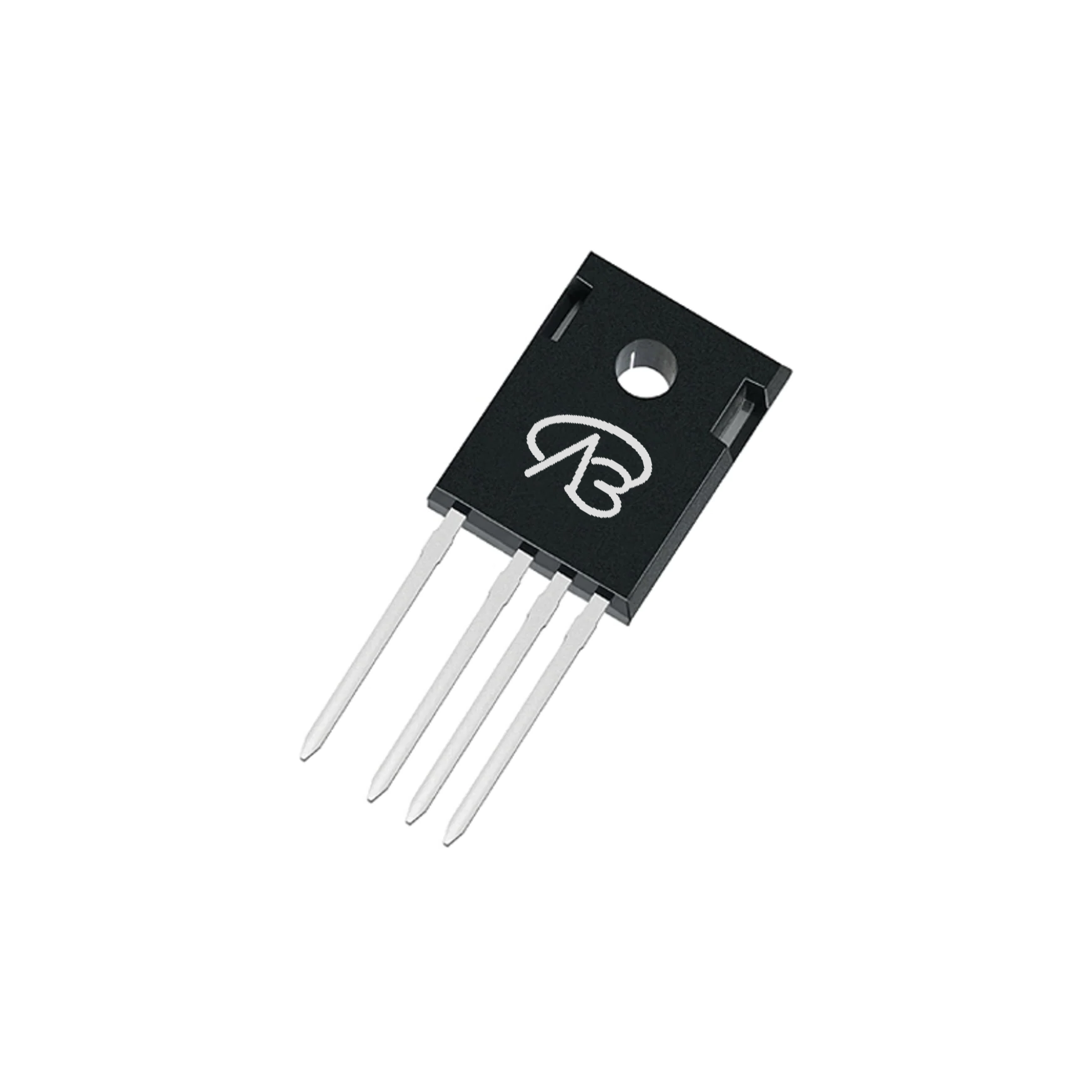
VBP165C70-4L: The Strategic Domestic Upgrade for Mid-High Voltage Power Systems, Surpassing the Qorvo UJ4C075018K4S
Driven by the global shift towards energy efficiency and supply chain resilience, the transition to domestic core power semiconductors has become a pivotal strategy. In mid-high voltage applications demanding robust performance and reliability, identifying a capable, high-quality, and supply-secure alternative is crucial for designers and manufacturers. Focusing on the established 750V N-channel MOSFET from Qorvo—the UJ4C075018K4S—the VBP165C70-4L from VBsemi emerges as a superior solution. It not only offers a reliable functional replacement but also enables a performance transformation through advanced Silicon Carbide (SiC) technology, shifting the value proposition from mere "substitution" to tangible "system upgrade."
I. Parameter Comparison and Performance Transformation: Inherent Advantages of SiC Technology
The UJ4C075018K4S has found its place in various power circuits thanks to its 750V voltage rating, 81A continuous current, and low on-state resistance. However, the switching losses and reverse recovery characteristics of traditional silicon-based devices can limit efficiency, especially in higher frequency operations.
1.While maintaining hardware compatibility with the TO-247-4L package, the VBP165C70-4L, built on SiC technology, delivers fundamental performance enhancements:
Superior Switching Performance: The SiC MOSFET structure inherently features ultra-fast switching speed, significantly lower gate charge (Qg), and near-zero reverse recovery charge (Qrr). This drastically reduces switching losses compared to the silicon-based reference model, enabling higher frequency operation, improved efficiency, and reduced EMI.
2. High-Temperature Operation and Stability: SiC material excels at high temperatures. The VBP165C70-4L maintains excellent on-resistance stability and switching characteristics even at elevated junction temperatures, enhancing system reliability in demanding environments.
3. Optimized Conduction at Rated Voltage: With a 650V VDS rating and an RDS(on) of 30mΩ, the device is expertly tailored for applications within this voltage range (e.g., 400V bus systems). Its performance ensures lower conduction losses within its operational scope, contributing to overall system efficiency.
II. Deepening Application Scenarios: Enabling Higher Performance Designs
The VBP165C70-4L allows for a direct pin-to-pin replacement in existing designs using the UJ4C075018K4S, while its SiC advantages can be leveraged for system-level improvements:
1. Industrial & Telecom SMPS
In switch-mode power supplies, the reduced switching losses allow for higher switching frequencies, leading to smaller magnetic components (transformers, inductors) and increased power density without compromising efficiency.
2. Photovoltaic Inverters & Energy Storage Systems (PCS)
For 400V-class solar or battery systems, its fast switching and high-temperature capability improve inverter efficiency and reliability, maximizing energy harvest and system uptime.
3. Motor Drives & UPS
In motor drive circuits and uninterruptible power supplies, the low switching loss characteristic reduces heat generation, simplifies thermal management, and supports more compact and efficient designs.
4. EV Auxiliary Power Supplies
Suitable for onboard DC-DC converters and other auxiliary power modules in electric vehicles, where efficiency and high-temperature performance are critical for range and reliability.
III. Beyond Parameters: Reliability, Supply Chain, and Total Cost of Ownership
Selecting the VBP165C70-4L is a comprehensive decision encompassing technical and strategic benefits:
1. Guaranteed Supply Chain Security
VBsemi controls the full vertical chain from SiC wafer to packaged product, ensuring a stable, predictable, and resilient supply. This mitigates risks associated with geopolitical trade tensions and long lead times, securing production plans for customers.
2. Total Cost Advantage
Beyond a competitive initial price, the efficiency gains from SiC technology can lower system-level costs (smaller heatsinks, passive components) and operational costs (reduced energy loss), offering a superior total cost of ownership.
3. Localized Engineering Partnership
VBsemi provides direct, responsive technical support throughout the design cycle—from simulation and prototyping to validation and failure analysis—accelerating time-to-market and problem resolution.
IV. Recommended Replacement and Validation Path
For designs currently utilizing the UJ4C075018K4S, a structured transition to the VBP165C70-4L is recommended:
1. Circuit Performance Evaluation
Conduct side-by-side testing under typical operating conditions. Focus on analyzing switching waveforms, loss breakdown, and efficiency curves. Optimize gate drive resistance (Rg) to fully exploit the VBP165C70-4L's fast switching capability while managing dv/dt.
2. Thermal and EMI Assessment
The reduced switching loss will lower thermal stress. Re-evaluate heatsink requirements for potential size or cost reduction. Verify that the faster switching edges comply with system EMI specifications; gate drive tuning or minor snubber adjustments may be beneficial.
3. System-Level Reliability Validation
Perform standard qualification tests (HTRB, H3TRB, power cycling, etc.) followed by rigorous system-level and field testing to ensure long-term reliability meets application standards.
Driving the Future with Domestic SiC Innovation
The VBsemi VBP165C70-4L is more than a direct alternative; it is a forward-looking SiC MOSFET solution that empowers next-generation power systems. Its exceptional switching speed, high-temperature resilience, and efficiency enable significant advancements in power density and performance for a wide range of mid-high voltage applications.
In an era prioritizing efficiency and supply chain independence, adopting the VBP165C70-4L represents both a smart technical upgrade and a strategic supply chain decision. We confidently recommend this product and look forward to partnering with you to build more efficient and reliable power electronics systems.


 Download now
 中文
中文 English
 Back to previous page


