Breaking Through and Surpassing: How Domestic Power MOSFET VB1695 Achieves High-Performance Substitution for RENESAS IDT RQK0604IGDQA#H1
Introduction
Power MOSFETs serve as fundamental switches managing energy flow in compact electronic circuits. For designs requiring reliable low-voltage switching, international components like RENESAS's IDT RQK0604IGDQA#H1 have been a common choice. However, evolving supply dynamics and the pursuit of design flexibility are driving the need for capable domestic alternatives. Represented by VBsemi's VB1695, domestic MOSFETs now offer direct pin-to-pin replacement with enhanced performance.
Part 1: Analysis of the Classic Component
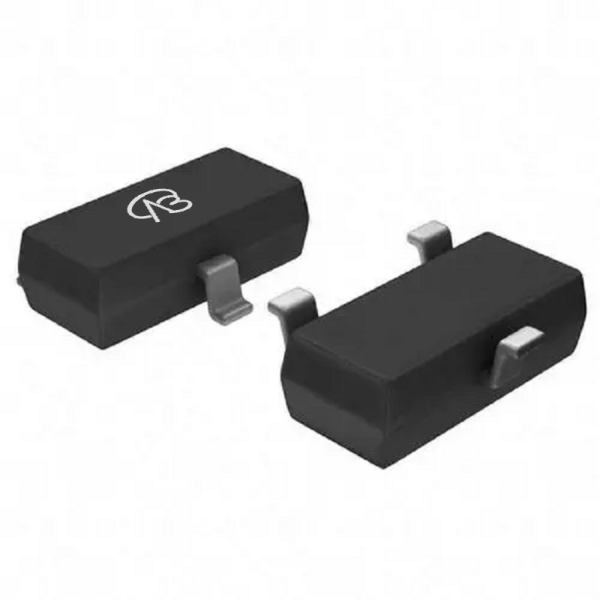
RENESAS's RQK0604IGDQA#H1 is a 60V, 2A N-channel MOSFET in a compact SOT-23-3 package. With a specified on-resistance (RDS(on)) of 180mΩ at VGS=2.5V and a power dissipation rating of 800mW, it is suited for various low-power switching applications, such as load switching, power management in portable devices, and signal amplification.
Part 2: Performance Surpassing by the Domestic Challenger
VBsemi's VB1695 directly competes with the RQK0604IGDQA#H1 and demonstrates superior key parameters:
Higher Current Capacity: Continuous drain current rating is 4A, doubling the 2A rating of the classic part, enabling handling of higher load currents.
Lower Conduction Loss: Features a remarkably low on-resistance of 75mΩ at VGS=10V (and a competitive value at 4.5V), significantly reducing conduction losses compared to the 180mΩ@2.5V of the counterpart, leading to improved efficiency and reduced heat generation.
Robust Gate Handling: Gate-source voltage (VGS) rating of ±20V offers a wider safe operating margin for gate drive signals.
Seamless Compatibility: Offered in the same industry-standard SOT-23-3 package, enabling direct drop-in replacement without board re-layout.
Part 3: Core Value Beyond Specifications
Selecting this domestic alternative delivers additional strategic advantages:
Supply Chain Resilience: Mitigates risks associated with single-source international supply chains, ensuring greater stability and continuity for production.
Cost-Structure Optimization: Provides excellent cost-performance ratio, potentially lowering system cost and allowing for design optimizations in related circuits.
Agile Local Support: Enables faster access to technical support and collaborative problem-solving tailored to specific application needs.
Strengthening the Domestic Ecosystem: Adoption contributes to the growth and technical maturation of the domestic semiconductor industry.
Part 4: A Robust Path for Substitution Implementation
For a successful and smooth design transition, a structured approach is recommended:
Detailed Parameter Comparison: Conduct a thorough review of all electrical specifications and characteristic curves.
Rigorous Bench Testing: Perform validation tests including static parameters, dynamic switching behavior, thermal performance, and reliability under stress.
Pilot Verification in Real Applications: Test the component in actual end-product prototypes to assess long-term performance under real-world conditions.
Develop a Phased Switchover Plan: Implement the substitution in phases post-verification, while maintaining the original part as a short-term backup option.
Conclusion: Advancing from "Adequate" to "Superior"
The progression from the RQK0604IGDQA#H1 to the VB1695 illustrates that domestic power semiconductors have reached a level where they can not only match but exceed the capabilities of established international parts in key metrics. Adopting such high-performance domestic components is a practical step to enhance supply chain security and a strategic investment in building a more autonomous, resilient, and innovative technological foundation for the future. The time is right to actively evaluate and integrate these superior domestic solutions.


 Download now
 中文
中文 English
 Back to previous page


