 中文
中文 English
MOSFET Selection for Industrial and Compact Power: SQD50N10-8M9L_GE3, SI2318CDS-T1-BE3 vs. China Alternatives VBE1105, VB1435
Number of views:9999
 Back to previous page
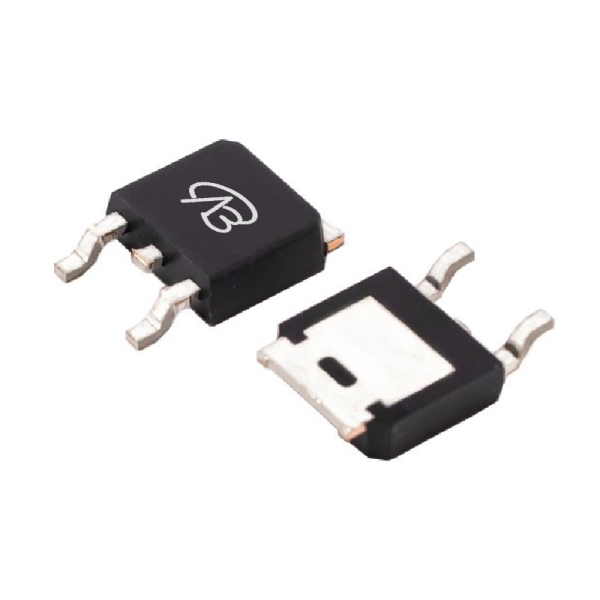
Comparative Analysis: SQD50N10-8M9L_GE3 (N-channel) vs. VBE1105
Analysis of the Original Model (SQD50N10-8M9L_GE3) Core:
This is a 100V N-channel MOSFET from VISHAY in a TO-252 (DPAK) package. Its design core is to deliver robust power handling and reliable performance in industrial-grade applications. Key advantages include a high continuous drain current rating of 50A and an on-resistance (RDS(on)) of 8.9mΩ measured at 10V gate drive. This combination makes it suitable for applications requiring high current throughput with moderate conduction losses.
Compatibility and Differences of the Domestic Alternative (VBE1105):
VBsemi's VBE1105 is also offered in a TO-252 package, providing direct pin-to-pin compatibility. The key differences are found in enhanced electrical parameters: VBE1105 boasts a significantly lower on-resistance of 5mΩ (at 10V) and a higher continuous drain current rating of 100A, while maintaining the same 100V drain-source voltage rating. This represents a substantial performance upgrade in terms of conduction loss and current-carrying capacity.
Key Application Areas:
Original Model SQD50N10-8M9L_GE3: Its 50A current capability and 100V rating make it well-suited for medium-to-high power switching applications.
Industrial Motor Drives: Controlling brushed DC or as a switch in BLDC motor drives.
Power Supplies: Used in the primary or secondary side of AC-DC or DC-DC converters for 48V/60V systems.
Battery Management Systems (BMS): As a discharge/protection switch in high-current battery packs.
Alternative Model VBE1105: With its superior 5mΩ RDS(on) and 100A current rating, it is an excellent "performance-enhanced" drop-in replacement. It is ideal for upgrade scenarios or new designs demanding lower conduction losses, higher efficiency, and greater power density in similar high-current 100V applications, such as next-generation high-power motor controllers or more efficient server power supplies.
Comparative Analysis: SI2318CDS-T1-BE3 (N-channel) vs. VB1435
This comparison shifts focus to space-constrained, lower-power applications where miniaturization and efficiency are paramount.
Analysis of the Original Model (SI2318CDS-T1-BE3) Core:
This is a small-signal N-channel MOSFET from VISHAY in a SOT-23 package. Its design pursues a balance of adequate performance within an ultra-compact footprint. It features a 40V drain-source voltage, a continuous drain current of 4.3A (up to 5.6A under specific conditions), and an on-resistance of 42mΩ at 10V gate drive. Its core advantage lies in providing reliable switching capability for low-power circuits in a minimal board space.
Compatibility and Differences of the Domestic Alternative (VB1435):
VBsemi's VB1435 is a direct pin-to-pin compatible alternative in the SOT-23-3 package. The parameters show a very close match, with VB1435 offering a slightly lower on-resistance of 35mΩ (at 10V) compared to the original's 42mΩ, and a comparable continuous current rating of 4.8A. Both share the same 40V voltage rating. This makes VB1435 a highly equivalent or marginally superior drop-in replacement.
Key Application Areas:
Original Model SI2318CDS-T1-BE3: Its compact size and sufficient ratings make it a classic choice for low-power, space-sensitive applications.
Load Switching: Power domain control in portable devices, IoT modules, and consumer electronics.
DC-DC Converters: Serving as the switching element in low-current step-down (buck) or step-up (boost) converters.
Signal Switching and Level Translation.
Alternative Model VB1435: As a functionally and parametrically equivalent domestic alternative, VB1435 is perfectly suited for the same application spaces—load switches, compact DC-DC converters, and peripheral power management—where supply chain diversification, cost optimization, or slight efficiency improvement (due to lower RDS(on)) is desired.
Conclusion
In summary, this analysis reveals two distinct substitution strategies:
For the high-power SQD50N10-8M9L_GE3 in TO-252 package, the domestic alternative VBE1105 offers a significant performance upgrade with dramatically lower on-resistance (5mΩ vs. 8.9mΩ) and higher current capability (100A vs. 50A), making it an excellent choice for enhancing efficiency and power density in industrial motor drives, power supplies, and BMS.
For the compact SI2318CDS-T1-BE3 in SOT-23 package, the domestic alternative VB1435 provides a nearly identical, pin-to-pin compatible solution with slightly better on-resistance (35mΩ vs. 42mΩ). It serves as a reliable and readily available alternative for load switching and DC-DC conversion in space-constrained portable and IoT devices.
The core takeaway is that selection hinges on precise requirement matching. In the era of supply chain diversification, domestic alternatives like VBE1105 and VB1435 not only provide viable backup options but also offer opportunities for performance enhancement or cost-effective equivalence, granting engineers greater flexibility and resilience in their design trade-offs.

Download PDF document
 Download now


