 中文
中文 English
MOSFET Selection for High-Power Applications: STWA32N65DM6AG, STW20NK50Z vs. China Alternatives VBP165R36S, VBP15R50S
Number of views:9999
 Back to previous page
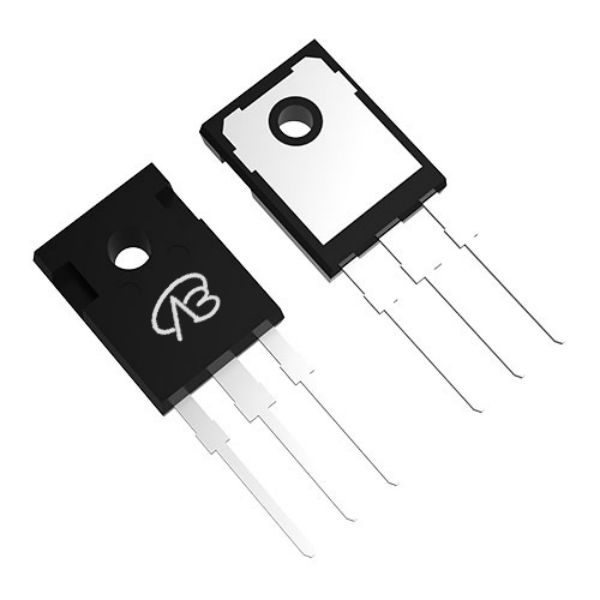
Comparative Analysis: STWA32N65DM6AG (650V N-channel) vs. VBP165R36S
Analysis of the Original Model (STWA32N65DM6AG) Core:
This is an automotive-grade N-channel 650V MOSFET from STMicroelectronics, utilizing the robust TO-247 long-lead package. Its design core is to balance high voltage capability with low conduction loss in demanding applications. Key advantages include: a high continuous drain current rating of 37A, a typical on-resistance (RDS(on)) of 83mΩ, and a high power dissipation capability of 320W. It features ST's MDmesh DM6 technology, optimized for high efficiency and fast switching in hard-switching topologies.
Compatibility and Differences of the Domestic Alternative (VBP165R36S):
VBsemi's VBP165R36S is also housed in a TO-247 package and serves as a pin-to-pin compatible alternative. The main differences lie in the electrical parameters: while both are rated for 650V, the VBP165R36S offers a significantly lower on-resistance of 75mΩ (at 10V Vgs) compared to the original's 97mΩ (max). Its continuous current rating is 36A, slightly lower than the original's 37A, but it utilizes a Super Junction Multi-EPI process, potentially offering favorable switching characteristics.
Key Application Areas:
Original Model STWA32N65DM6AG: Its automotive-grade qualification, high current capability, and good thermal performance make it ideal for demanding high-power applications.
Automotive Systems: On-board chargers (OBC), DC-DC converters, and other high-voltage auxiliary power supplies.
Industrial Power Supplies: High-efficiency SMPS (Switched-Mode Power Supplies), PFC (Power Factor Correction) stages.
Renewable Energy: Inverters for solar and UPS systems.
Alternative Model VBP165R36S: With its lower on-resistance, it is well-suited for applications where reducing conduction losses is a priority within the 650V/36A range, such as in high-efficiency server power supplies or industrial motor drives, offering a potential performance upgrade in conduction loss.
Comparative Analysis: STW20NK50Z (500V N-channel) vs. VBP15R50S
This comparison focuses on 500V-rated MOSFETs, where the design pursuit shifts towards optimizing cost-effectiveness for medium-high power applications.
Analysis of the Original Model (STW20NK50Z) Core:
The STW20NK50Z is a 500V, 20A N-channel MOSFET in a TO-247AC-3 package. Its core advantages are a balanced performance set for its voltage class: a specified on-resistance of 270mΩ (at 10V, 10A) and a continuous current of 20A. It provides a reliable and cost-effective solution for standard 500V applications.
Compatibility and Differences of the Domestic Alternative (VBP15R50S):
The domestic alternative VBP15R50S represents a substantial "performance-enhanced" choice. While maintaining the same TO-247 package compatibility and a 500V voltage rating, it offers dramatically improved key parameters: a much lower on-resistance of 80mΩ (at 10V Vgs) and a significantly higher continuous current rating of 50A. This indicates substantially reduced conduction losses and higher current-handling capability.
Key Application Areas:
Original Model STW20NK50Z: Its balanced parameters make it a suitable choice for standard 500V applications with moderate current demands.
Low-Power Motor Drives: For appliances, fans, and pumps.
AC-DC Power Supplies: For industrial controls, lighting, and auxiliary power.
General-Purpose Inverters.
Alternative Model VBP15R50S: With its ultra-low RDS(on) and high current capability, it is ideal for upgraded scenarios demanding higher efficiency, higher power density, or higher output current.
High-Current DC-DC Converters: In telecom or server power systems.
High-Power Motor Drives: For industrial tools, compressors, and e-mobility.
High-Efficiency PFC Circuits.
Summary
This comparative analysis reveals two distinct selection paths for high-voltage applications:
For 650V automotive-grade and high-reliability applications, the original model STWA32N65DM6AG, with its AEC-Q101 qualification, 37A current rating, and robust 320W power dissipation, demonstrates strong advantages in automotive and industrial systems where reliability is paramount. Its domestic alternative VBP165R36S, while package-compatible, offers a lower on-resistance (75mΩ vs. 97mΩ), making it an attractive option for applications prioritizing minimized conduction loss within the 36A range.
For 500V medium-high power applications, the original model STW20NK50Z provides a cost-effective, balanced solution for standard 20A applications. In contrast, the domestic alternative VBP15R50S delivers a remarkable performance leap, with its 80mΩ on-resistance and 50A current rating, making it a compelling upgrade for designs requiring higher efficiency, higher power output, or future headroom.
The core conclusion is: Selection is about precise requirement matching. In the context of supply chain diversification, domestic alternatives not only provide viable backup options but can also offer significant parametric advantages—lower RDS(on) and higher current—giving engineers more flexible and resilient choices for design optimization and cost control. Understanding the design focus and parameter implications of each device is key to maximizing its value in the circuit.

Download PDF document
 Download now


