 中文
中文 English
MOSFET Selection for Automotive Power Applications: NVD5C454NLT4G, NTD5C648NLT4G vs. China Alternatives VBE1402, VBGE1603
Number of views:9999
 Back to previous page
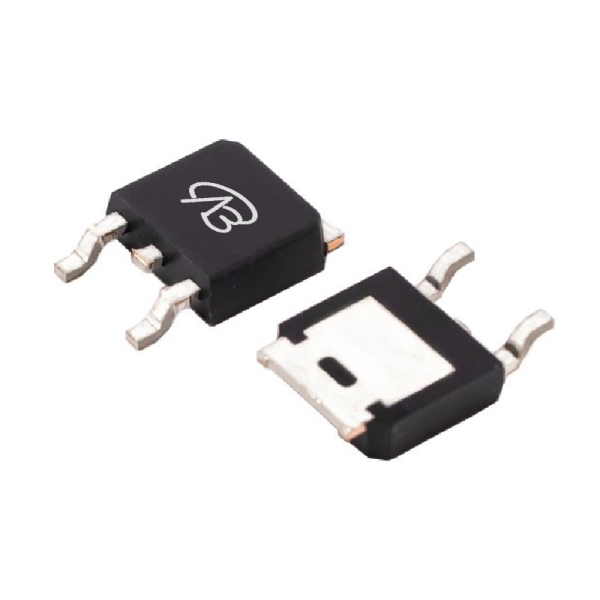
Comparative Analysis: NVD5C454NLT4G (40V N-channel) vs. VBE1402
Analysis of the Original Model (NVD5C454NLT4G) Core:
This is a 40V N-channel MOSFET from onsemi, packaged in the industry-standard DPAK. Its design core is to achieve high efficiency and power density in automotive applications. Key advantages include: a very low on-resistance of 3.3mΩ at 10V gate drive, a high continuous drain current rating of 20A (84A under specific pulsed conditions), and excellent thermal performance from the DPAK package. Crucially, it is AEC-Q101 qualified and supports PPAP, making it suitable for demanding automotive environments.
Compatibility and Differences of the Domestic Alternative (VBE1402):
VBsemi's VBE1402 offers a direct pin-to-pin compatible alternative in the TO-252 (DPAK) package. The key differences lie in the electrical parameters: VBE1402 matches the 40V voltage rating but significantly surpasses the original in current capability, rated for 120A continuous current. Its on-resistance is also lower, at 1.6mΩ @10V compared to the original's 3.3mΩ.
Key Application Areas:
Original Model NVD5C454NLT4G: Its combination of low RDS(on), 40V rating, and AEC-Q101 certification makes it ideal for compact, high-efficiency automotive power modules. Typical applications include:
Automotive DC-DC Converters: As a synchronous rectifier or switch in 12V/24V battery systems.
Engine Management & Drivetrain: Solenoid drivers, fuel injector drivers, or transmission control units.
Body Control Modules: For driving relays or loads in lighting, wipers, or power windows.
Alternative Model VBE1402: This is a "performance-enhanced" alternative, better suited for applications within the same 40V range but requiring significantly higher current handling (up to 120A) and lower conduction losses. It is an excellent upgrade for high-current power paths, motor drives, or where improved thermal performance is needed.
Comparative Analysis: NTD5C648NLT4G (60V N-channel) vs. VBGE1603
This 60V N-channel MOSFET is designed for applications requiring a higher voltage margin while maintaining low conduction loss and high current capability.
Analysis of the Original Model (NTD5C648NLT4G) Core:
The core advantages of this onsemi MOSFET are its balanced performance at 60V: a low on-resistance of 4.1mΩ at 10V gate drive, a very high continuous drain current of 91A, and logic-level gate compatibility. The DPAK package provides reliable power dissipation for its rating.
Compatibility and Differences of the Domestic Alternative (VBGE1603):
VBsemi's VBGE1603 is a direct pin-to-pin compatible alternative in TO-252 (DPAK). It matches the 60V voltage rating but offers superior performance in key areas: a higher continuous current rating of 120A and a competitive on-resistance of 3.4mΩ @10V. It utilizes SGT (Shielded Gate Trench) technology for good switching performance.
Key Application Areas:
Original Model NTD5C648NLT4G: Its 60V rating, high current (91A), and low RDS(on) make it a strong candidate for automotive systems with higher voltage transients or for 48V mild-hybrid systems. Applications include:
Higher Voltage DC-DC Conversion: In 48V-to-12V converters or boost/buck regulators.
Electric Power Steering (EPS) Drives: Motor drive circuits requiring 60V rating.
Battery Management Systems (BMS): For discharge control or protection switches.
Alternative Model VBGE1603: This alternative provides a compelling upgrade path, offering even higher current capacity (120A) for applications pushing the power limits within the 60V range. It is suitable for next-generation designs demanding higher power density and efficiency from the same footprint.
Conclusion:
In summary, this analysis reveals clear selection and upgrade paths for automotive N-channel MOSFETs:
For 40V automotive applications, the original NVD5C454NLT4G, with its AEC-Q101 qualification, low 3.3mΩ RDS(on), and 20A/84A current rating, is a proven, reliable choice for standard automotive power modules. Its domestic alternative VBE1402 provides significant "performance headroom," with a much lower 1.6mΩ RDS(on) and a massive 120A current rating, making it an excellent choice for designs requiring maximum efficiency and current capability within the same voltage and package.
For 60V automotive applications, the original NTD5C648NLT4G offers a robust solution with 4.1mΩ RDS(on) and 91A current in a DPAK package. The domestic alternative VBGE1603 stands as a "high-performance" equivalent, matching the voltage, offering a superior 120A current rating, and a low 3.4mΩ RDS(on), enabling more powerful or efficient designs in the same form factor.
The core takeaway is that selection must be driven by precise application requirements—voltage, current, loss, and qualification. In the context of supply chain diversification, domestic alternatives like VBE1402 and VBGE1603 not only provide reliable, pin-compatible options but also offer performance advantages in key parameters, giving engineers greater flexibility and resilience in design trade-offs and cost management for automotive power systems.

Download PDF document
 Download now


