 中文
中文 English
MOSFET Selection for Automotive and High-Power Applications: NVD3055-150T4G-VF01, FDMS86350ET80 vs. China Alternatives VBE1695, VBGQA1803
Number of views:9999
 Back to previous page
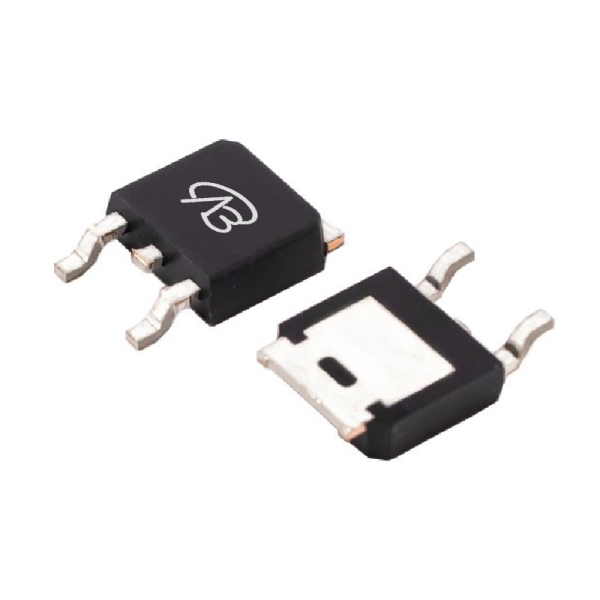
Comparative Analysis: NVD3055-150T4G-VF01 (N-channel) vs. VBE1695
Analysis of the Original Model (NVD3055-150T4G-VF01) Core:
This is an AEC-Q101 qualified, PPAP-capable N-channel MOSFET from onsemi in a TO-252 (DPAK) package. Its design core is to provide reliable, low-to-medium power switching for automotive environments. Key advantages include a 60V drain-source voltage rating, a continuous drain current of 9A, and an on-resistance (RDS(on)) of 122mΩ @10V. It is specifically engineered for low-voltage, high-speed switching in automotive applications like power supplies, converters, motor control, and bridge circuits.
Compatibility and Differences of the Domestic Alternative (VBE1695):
VBsemi's VBE1695 offers a direct pin-to-pin compatible alternative in the same TO-252 package. The key differences are in electrical performance: while both are 60V N-channel devices, the VBE1695 shows significantly improved conduction characteristics. It features a lower on-resistance of 73mΩ @10V and a much higher continuous current rating of 18A compared to the original model's 9A.
Key Application Areas:
Original Model NVD3055-150T4G-VF01: Its primary strength is its automotive-grade qualification, making it the mandatory choice for applications requiring AEC-Q101 compliance, such as automotive body control modules, pump drivers, and low-power DC-DC conversion.
Alternative Model VBE1695: This model is an excellent performance-enhanced alternative for applications where formal automotive certification is not strictly required but higher efficiency and current capability are desired. It is suitable for industrial power supplies, motor drives, and converter circuits that benefit from its lower RDS(on) and higher current rating.
Comparative Analysis: FDMS86350ET80 (N-channel) vs. VBGQA1803
This comparison shifts focus to high-current, ultra-low-loss power switching applications.
Analysis of the Original Model (FDMS86350ET80) Core:
This onsemi N-channel MOSFET in a Power-56-8 package utilizes advanced PowerTrench technology. Its design pursuit is the minimization of conduction loss while maintaining robust switching performance. Core advantages are an ultra-low on-resistance of 2.4mΩ @10V and an exceptionally high continuous drain current of 198A at 80V. It is engineered for applications demanding maximum efficiency in high-power conversion.
Compatibility and Differences of the Domestic Alternative (VBGQA1803):
VBsemi's VBGQA1803, in a DFN8(5x6) package, presents a compelling alternative with a similar performance profile. While the package differs, it serves analogous high-power applications. The VBGQA1803 offers a comparable 80V rating and an impressively low RDS(on) of 2.65mΩ @10V. Its continuous current rating is 140A, which, while lower than the original's 198A, remains suitable for a vast range of high-power scenarios.
Key Application Areas:
Original Model FDMS86350ET80: Its extreme current handling and ultra-low RDS(on) make it ideal for the most demanding high-power applications, such as synchronous rectification in high-current server/telecom power supplies, high-performance motor drives, and power stages in industrial inverters.
Alternative Model VBGQA1803: This model is a highly competitive alternative for applications prioritizing a compact footprint (DFN package) alongside high performance. It is well-suited for high-density DC-DC converters, motor controllers, and power management modules where its 140A capability and 2.65mΩ RDS(on) provide significant efficiency gains.
Conclusion:
In summary, this analysis reveals two distinct selection pathways based on application priority:
For automotive and reliability-critical low-to-medium power switching, the AEC-Q101 certified NVD3055-150T4G-VF01 remains the essential choice. Its domestic alternative VBE1695 offers a performance-upgraded option with lower RDS(on) and higher current for non-automotive or reliability-derated applications where its enhanced electrical parameters are beneficial.
For ultra-high-efficiency, high-power switching, the FDMS86350ET80 sets a benchmark with its 198A current and 2.4mΩ RDS(on). The domestic alternative VBGQA1803 provides a compelling solution with a different package (DFN), offering excellent performance (140A, 2.65mΩ) for designs seeking high power density and efficiency.
The core takeaway is that selection is not about absolute superiority but precise requirement matching. In the context of supply chain diversification, domestic alternatives like VBE1695 and VBGQA1803 not only provide viable backup options but also offer performance enhancements or form-factor benefits, giving engineers greater flexibility in design trade-offs and cost optimization. Understanding the design intent and parametric implications of each device is key to unlocking its full potential in your circuit.

Download PDF document
 Download now


