 中文
中文 English
MOSFET Selection for Compact Power and Automotive Applications: NTF3055-100T1G, NVMFS4C05NWFT1G vs. China Alternatives VBJ1695, VBQA1303
Number of views:9999
 Back to previous page
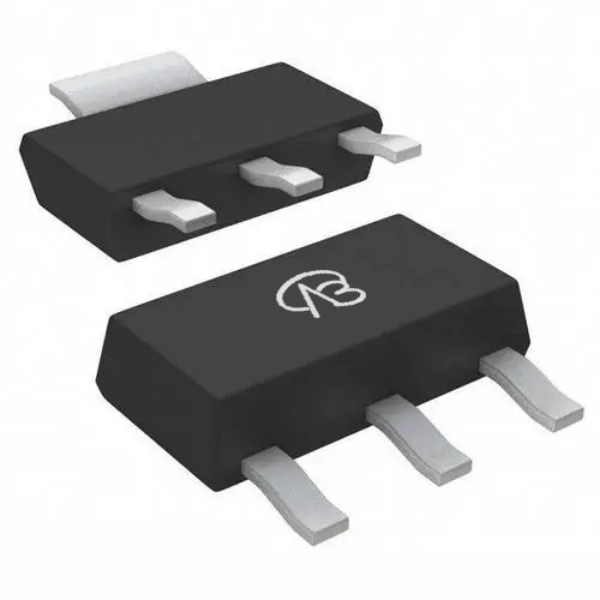
Comparative Analysis: NTF3055-100T1G (N-channel) vs. VBJ1695
Analysis of the Original Model (NTF3055-100T1G) Core:
This is a 60V N-channel MOSFET from onsemi, housed in a compact SOT-223 package. Its design core is to provide reliable low-voltage, high-speed switching in a cost-effective form factor. Key advantages include: a drain-source voltage (Vdss) of 60V, a continuous drain current (Id) of 3A, and an on-resistance (RDS(on)) of 110mΩ at 10V gate drive. It is well-suited for various power switching applications.
Compatibility and Differences of the Domestic Alternative (VBJ1695):
VBsemi's VBJ1695 offers a direct pin-to-pin compatible alternative in the same SOT-223 package. The main differences are in enhanced electrical parameters: VBJ1695 features a significantly lower on-resistance of 76mΩ at 10V (vs. 110mΩ for the original) and a higher continuous drain current rating of 4.5A (vs. 3A). This translates to lower conduction losses and the ability to handle higher currents in similar applications.
Key Application Areas:
Original Model NTF3055-100T1G: Ideal for general-purpose, cost-sensitive applications requiring 60V switching at currents up to 3A. Typical uses include power supplies, converters, power motor control, and bridge circuits where low-voltage high-speed switching is needed.
Alternative Model VBJ1695: A performance-enhanced drop-in replacement, better suited for applications demanding lower conduction loss, higher current capability (up to 4.5A), and improved efficiency within the same 60V rating and footprint.
Comparative Analysis: NVMFS4C05NWFT1G (N-channel) vs. VBQA1303
This comparison shifts focus to high-performance, automotive-grade MOSFETs where low resistance, high current, and reliability are paramount.
Analysis of the Original Model (NVMFS4C05NWFT1G) Core:
This is a robust 30V N-channel MOSFET from onsemi, featuring an SO-8-FL (5x6mm) package with flat leads for superior thermal performance. Its design core is to deliver high power density and efficiency for demanding automotive environments. Key strengths are: an extremely low on-resistance of 2.3mΩ at 10V, an exceptionally high continuous drain current of 127A, and compliance with AEC-Q101 standards including PPAP for automotive use.
Compatibility and Differences of the Domestic Alternative (VBQA1303):
VBsemi's VBQA1303 serves as a compelling domestic alternative in a DFN8(5x6) package, offering similar compact dimensions. It presents a highly competitive parameter set: a similar voltage rating of 30V, a slightly lower but still very high continuous current of 120A, and a remarkably low on-resistance of 3mΩ at 10V. While the RDS(on) is marginally higher than the original's 2.3mΩ, it remains in the ultra-low range, making it suitable for high-current applications.
Key Application Areas:
Original Model NVMFS4C05NWFT1G: The benchmark for compact, high-efficiency automotive designs. Its ultra-low RDS(on) and very high current rating make it perfect for demanding applications like motor drives, solenoid control, and high-current DC-DC converters in 12V/24V automotive systems, where AEC-Q101 qualification is essential.
Alternative Model VBQA1303: A strong domestic alternative for applications requiring high current handling (up to 120A) and low conduction loss in a compact package. It is well-suited for automotive or industrial power systems where supply chain diversification is valued, offering a robust performance profile for high-power switching tasks.
Conclusion:
This analysis reveals two distinct selection pathways:
For general-purpose 60V switching, the original NTF3055-100T1G provides a reliable, cost-effective solution. Its domestic alternative, VBJ1695, offers a performance upgrade with lower RDS(on) and higher current capability in the same package, making it an excellent choice for efficiency-focused replacements or new designs.
For high-current automotive or compact power applications, the onsemi NVMFS4C05NWFT1G sets a high standard with its ultra-low resistance and AEC-Q101 pedigree. The domestic alternative VBQA1303 emerges as a viable and powerful contender, delivering very high current (120A) and low resistance (3mΩ) in a similar form factor, providing a resilient alternative for the supply chain.
The core takeaway is that selection hinges on precise requirement matching. Domestic alternatives like VBJ1695 and VBQA1303 not only offer reliable compatibility but also bring performance enhancements or robust parity, granting engineers greater flexibility in design trade-offs and cost management within a diversified component landscape.

Download PDF document
 Download now


