 中文
中文 English
MOSFET Selection for Automotive & Power Applications: NTD25P03LT4G, NVMFS5C645NLAFT1G vs. China Alternatives VBE2338, VBQA1606
Number of views:9999
 Back to previous page
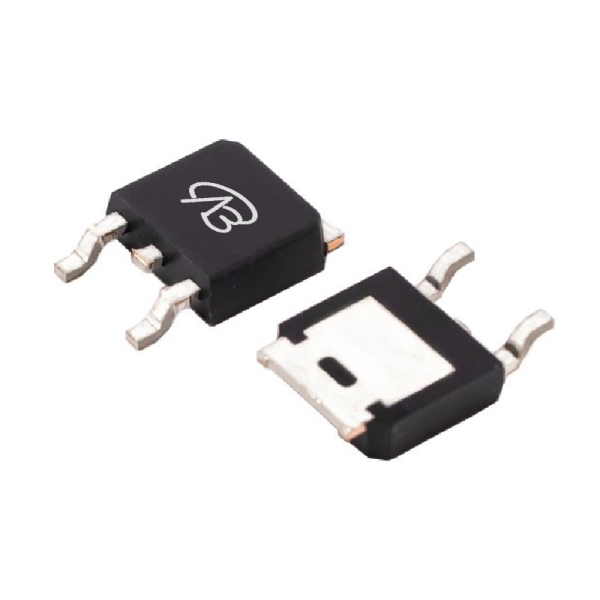
Comparative Analysis: NTD25P03LT4G (P-channel) vs. VBE2338
Analysis of the Original Model (NTD25P03LT4G) Core:
This is a 30V P-channel MOSFET from onsemi in a DPAK package. Its design core is optimized for low-voltage, high-speed switching applications requiring ruggedness. Key advantages include: a continuous drain current rating of 25A, an on-resistance (RDS(on)) of 51mΩ at 5V gate drive, and robust construction capable of withstanding high energy in avalanche and commutation modes. Notably, its source-to-drain diode recovery time is comparable to that of a discrete fast recovery diode, minimizing reverse recovery losses in switching circuits.
Compatibility and Differences of the Domestic Alternative (VBE2338):
VBsemi's VBE2338, offered in a TO252 package (similar footprint to DPAK), serves as a pin-to-pin compatible alternative. The key parametric differences are: VBE2338 has a slightly higher voltage rating (-30V) and offers a lower on-resistance of 33mΩ at a 10V gate drive (vs. 51mΩ@5V for the original). However, its continuous current rating is -38A, which is higher than the original's 25A, potentially offering more margin in high-current applications.
Key Application Areas:
Original Model NTD25P03LT4G: Its blend of 25A current capability, fast diode recovery, and avalanche ruggedness makes it ideal for:
Low-voltage, high-speed power switching in industrial controls.
OR-ing and hot-swap circuits where fast diode behavior is crucial.
Motor pre-drive or solenoid drive applications in 12V/24V systems.
Alternative Model VBE2338: With its lower RDS(on) and higher current rating, it is well-suited for applications demanding lower conduction losses and higher current capacity within a similar voltage range, such as upgraded power switches or more efficient motor drives in similar systems.
Comparative Analysis: NVMFS5C645NLAFT1G (N-channel) vs. VBQA1606
This N-channel MOSFET represents the high end of automotive-grade performance, where power density, thermal management, and reliability are paramount.
Analysis of the Original Model (NVMFS5C645NLAFT1G) Core:
This is a 60V, AEC-Q101 qualified MOSFET from onsemi in a compact DFN-5 (5.9x4.9mm) package with wettable flanks for enhanced optical inspection. Its design core focuses on maximizing power delivery in a minimal footprint for automotive environments. Core advantages are exceptional: an ultra-low RDS(on) of 3.3mΩ at 10V gate drive, a very high continuous drain current of 100A, and excellent thermal performance from its power package. It is PPAP capable, making it a standard choice for demanding automotive applications.
Compatibility and Differences of the Domestic Alternative (VBQA1606):
VBsemi's VBQA1606, in a DFN8(5x6) package, is a form-factor compatible alternative designed for similar high-power applications. While it shares the same 60V voltage rating, its key parameters show a slight trade-off: it offers a slightly higher RDS(on) of 6mΩ at 10V and a continuous current rating of 80A, which are moderately lower than the original's stellar 3.3mΩ and 100A. However, it remains a highly capable device for many high-current scenarios.
Key Application Areas:
Original Model NVMFS5C645NLAFT1G: Its ultra-low resistance, very high current, and automotive-grade certification make it the premier choice for:
High-current DC-DC converters (e.g., POL, VRM) in automotive ADAS, infotainment, or powertrain systems.
Motor drive modules for electric pumps, fans, or window lifts requiring high efficiency and reliability.
Battery management system (BMS) discharge switches and other critical power path management in 48V systems.
Alternative Model VBQA1606: This model is an excellent alternative for applications where the original's extreme performance parameters are not fully required, but a robust, compact, and high-efficiency 60V solution is needed. It fits well in:
High-efficiency synchronous rectification in industrial power supplies.
Motor drives and solenoid drivers where 80A current capability is sufficient.
Providing a cost-effective and readily available alternative for automotive or industrial designs seeking supply chain diversification.
Conclusion
In summary, this analysis reveals two distinct selection pathways based on application rigor and performance requirements:
For rugged, fast-switching P-channel applications around 30V, the original NTD25P03LT4G offers proven reliability with fast diode recovery, making it a strong choice for industrial and automotive auxiliary systems. Its domestic alternative VBE2338 provides a compelling option with lower on-resistance and higher current capability, suitable for designs prioritizing conduction efficiency and current headroom.
For high-power, automotive-grade N-channel applications at 60V, the original NVMFS5C645NLAFT1G stands out with its best-in-class 3.3mΩ RDS(on) and 100A current in a compact, AEC-Q101 certified package, making it the top-tier choice for the most demanding automotive circuits. The domestic alternative VBQA1606 presents a viable, high-performance substitute with 6mΩ and 80A, offering a balanced solution for many high-current applications where full automotive-grade specs are beneficial but the utmost performance level can be traded for cost or availability.
The core takeaway is that selection is driven by precise requirement matching. In an era of supply chain diversification, domestic alternatives like VBE2338 and VBQA1606 not only provide reliable backup options but also offer competitive performance, giving engineers greater flexibility and resilience in design trade-offs and cost management. Understanding the specific design philosophy and parametric implications of each device is key to unlocking its full value in your circuit.

Download PDF document
 Download now


