 中文
中文 English
MOSFET Selection for High-Power & Automotive Applications: FQD19N10LTM, FDBL86366-F085 vs. China Alternatives VBE1101M, VBGQT1803
Number of views:9999
 Back to previous page
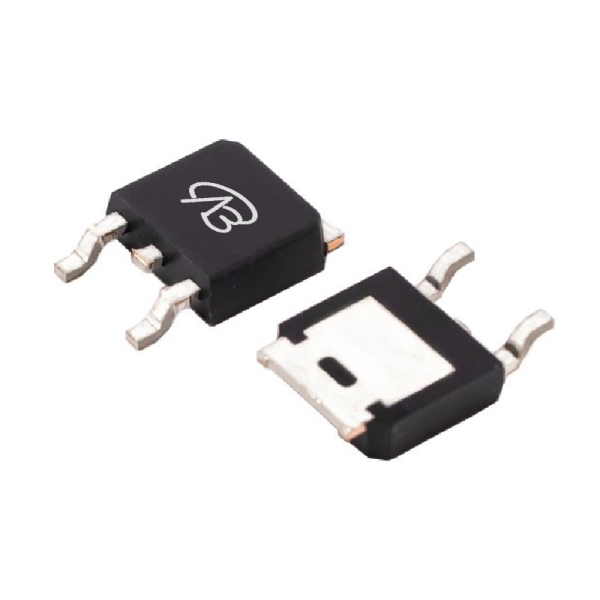
Comparative Analysis: FQD19N10LTM (N-channel) vs. VBE1101M
Analysis of the Original Model (FQD19N10LTM) Core:
This is a 100V N-channel MOSFET from onsemi in a standard DPAK (TO-252) package. Its design core leverages planar stripe and DMOS technology to achieve a balance of good switching performance, high avalanche energy capability, and a moderate on-resistance of 100mΩ at 10V gate drive. With a continuous drain current rating of 15.6A, it is built for robustness in various power conversion applications.
Compatibility and Differences of the Domestic Alternative (VBE1101M):
VBsemi's VBE1101M is offered in a TO-252 (likely pin-to-pin compatible) package as a general-purpose alternative. The key parameters show a close match: both are 100V, single N-channel devices. The VBE1101M has a slightly higher on-resistance (RDS(on)) of 114mΩ @ 10V compared to the original's 100mΩ, and a comparable continuous current rating of 15A. The threshold voltage is standard at 1.8V. This makes it a viable alternative where the slight increase in conduction loss is acceptable within the design margin.
Key Application Areas:
Original Model FQD19N10LTM: Its 100V rating and robust construction make it suitable for medium-power switching applications requiring good reliability. Typical uses include:
Switch-Mode Power Supplies (SMPS): In auxiliary or main power stages.
Audio Amplifiers: As part of the output stage.
DC Motor Control: For driving small to medium motors.
Variable Switching Power Supplies.
Alternative Model VBE1101M: Serves as a practical domestic alternative for the same application spaces as the FQD19N10LTM, particularly in cost-sensitive designs or where supply chain diversification is needed, accepting a minor compromise on RDS(on).
Comparative Analysis: FDBL86366-F085 (N-channel) vs. VBGQT1803
This comparison shifts to high-current, automotive-grade MOSFETs where ultra-low resistance and high reliability are paramount.
Analysis of the Original Model (FDBL86366-F085) Core:
This is a high-performance 80V N-channel MOSFET from onsemi in an HPSOF-8 package, designed for demanding automotive environments (AEC-Q101 qualified). Its core advantages are:
Exceptional Current Handling: Rated for a massive 220A continuous drain current and 300W power dissipation.
Ultra-Low Conduction Loss: Features a very low typical RDS(on) of 2.4mΩ at VGS=10V, ID=80A.
Automotive Ruggedness: Qualified for automotive applications like engine control and powertrain management, with UIS capability and PPAP support.
Compatibility and Differences of the Domestic Alternative (VBGQT1803):
VBsemi's VBGQT1803, in a TOLL package, presents itself as a "performance-competitive" alternative. It matches the 80V voltage rating but pushes the specifications even higher in some aspects:
Higher Current Rating: A remarkable 250A continuous drain current, surpassing the original's 220A.
Competitive Low RDS(on): At 2.65mΩ @ 10V, it is very close to the original's 2.4mΩ, ensuring similarly low conduction losses.
Advanced Technology: Utilizes SGT (Shielded Gate Trench) technology for good switching performance and low gate charge.
Key Application Areas:
Original Model FDBL86366-F085: Its automotive-grade qualification and high-power specs make it an ideal choice for:
Automotive Engine Control Units (ECU): For injector or ignition control.
Powertrain Management: In DC-DC converters, motor drives for pumps/fans.
High-Current DC-DC Conversion: In 48V systems or high-power server/telecom supplies.
Alternative Model VBGQT1803: Targets the same high-performance automotive and industrial applications. Its higher current rating and competitive RDS(on) make it suitable for direct upgrades or new designs requiring maximum current density and efficiency, provided package compatibility (TOLL vs. HPSOF-8) is addressed in the layout.
Conclusion
In summary, this analysis reveals two distinct selection scenarios:
For standard 100V, medium-current applications, the original FQD19N10LTM offers a reliable, well-balanced solution. Its domestic alternative VBE1101M provides a functionally similar, cost-effective option with slightly higher on-resistance, suitable for direct replacement in many cases.
For high-performance, automotive-grade 80V applications, the original FDBL86366-F085 sets a high bar with its ultra-low RDS(on), high current, and AEC-Q101 certification. The domestic alternative VBGQT1803 emerges as a formidable competitor, offering even higher current capability and very low on-resistance, making it an excellent choice for next-generation designs demanding peak power handling, though attention must be paid to package differences (HPSOF-8 vs. TOLL).
The core takeaway is that selection hinges on precise requirement matching. In the context of supply chain diversification, domestic alternatives like VBE1101M and VBGQT1803 not only provide viable backup options but also offer competitive or even enhanced specifications in key areas, giving engineers greater flexibility and resilience in design trade-offs and cost optimization. Understanding the specific design philosophy and parameter implications of each device is essential to unlocking its full potential in the circuit.

Download PDF document
 Download now


