 中文
中文 English
MOSFET Selection for Compact Signal & Power Switching: PMV33UPE,215, BSS84AKW,115 vs. China Alternatives VB2355, VBK264K
Number of views:9999
 Back to previous page
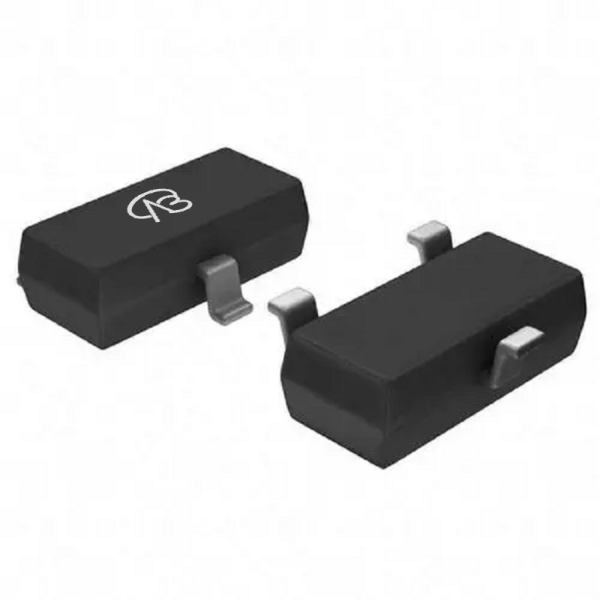
Comparative Analysis: PMV33UPE,215 (P-Channel) vs. VB2355
Analysis of the Original Model (PMV33UPE,215) Core:
This is a 20V P-Channel MOSFET from Nexperia in a compact TO-236AB (SOT-23) package. Its design core is to provide a robust balance of current handling and low on-resistance for general-purpose low-side switching or power management in space-constrained boards. Key advantages include: a continuous drain current rating of 4.4A and a relatively low on-resistance of 36mΩ (at Vgs=4.5V, 3A condition). This makes it suitable for switching moderate currents efficiently.
Compatibility and Differences of the Domestic Alternative (VB2355):
VBsemi's VB2355 is a direct pin-to-pin compatible alternative in an SOT23-3 package. The main differences are in electrical parameters: VB2355 offers a higher voltage rating (-30V vs. -20V), providing a wider safety margin. However, its on-resistance is higher at 54mΩ (@4.5V), and its continuous current rating is -5.6A. This indicates a trade-off: better voltage withstand capability but slightly higher conduction loss compared to the original part.
Key Application Areas:
Original Model PMV33UPE,215: Ideal for applications requiring a good balance of current (up to ~4A) and low RDS(on) in a standard SOT-23 footprint. Typical uses include:
Load switching and power distribution in consumer electronics.
Low-side switch in DC-DC converters or power management units (PMUs).
General-purpose switching in battery-operated devices.
Alternative Model VB2355: Suitable for applications where a higher voltage rating (-30V) is prioritized over the lowest possible on-resistance, or where the slightly higher current rating (-5.6A) is beneficial, still within compact SOT-23 constraints.
Comparative Analysis: BSS84AKW,115 (P-Channel) vs. VBK264K
This comparison shifts to ultra-low-power signal-level switching. The design pursuit here is minimal space consumption and control of very small currents.
Analysis of the Original Model (BSS84AKW,115) Core:
This is a 50V P-Channel MOSFET from Nexperia in a tiny SC-70 (SOT-323) package. Its core advantage is its high voltage capability in a minimal footprint for signal isolation, level shifting, or very light load switching. Key parameters are a 50V drain-source voltage, a continuous current of 150mA, and an on-resistance of 7.5Ω (@10V), which is acceptable for its intended micro-power applications.
Compatibility and Differences of the Domestic Alternative (VBK264K):
VBsemi's VBK264K is a pin-to-pin compatible alternative in an SC70-3 package. It presents a significant parameter shift: it offers an even higher voltage rating of -60V, making it robust for voltage-prone environments. However, its on-resistance is substantially higher (4000mΩ @10V vs. 7.5Ω), and its continuous current rating is lower at -0.135A (135mA). This defines it as a specialized part for very high-voltage, very low-current signal switching where leakage and voltage blocking are paramount.
Key Application Areas:
Original Model BSS84AKW,115: Perfect for space-critical, signal-level applications requiring a 50V rating. Typical uses include:
Signal line isolation or switching in communication interfaces.
Level shifting in low-voltage logic circuits.
Power gating for micro-power sensors or peripheral ICs.
Alternative Model VBK264K: Targets niche applications demanding an exceptionally high voltage rating (-60V) in an SC-70 package, but where higher on-resistance and lower current capability are acceptable. Think of high-voltage signal multiplexing or protection circuits with minimal current flow.
Conclusion:
This analysis reveals two distinct substitution strategies:
1. For general-purpose P-Channel switching in an SOT-23 package, the original PMV33UPE,215 offers a good performance balance. Its domestic alternative VB2355 provides a valid compatible option with a higher voltage rating (-30V), suitable for designs where voltage margin is more critical than achieving the absolute lowest RDS(on).
2. For ultra-compact, signal-level P-Channel switching in an SC-70 package, the original BSS84AKW,115 is a classic choice for 50V systems. Its alternative VBK264K serves a different, more specialized need by pushing the voltage rating to -60V, making it a compelling choice for high-voltage signal interfacing, despite its higher on-resistance.
The core takeaway is that selection is driven by precise application needs. Domestic alternatives like VB2355 and VBK264K not only offer supply chain diversification but also provide specific parameter enhancements (like higher voltage ratings) that can be strategically leveraged in the right design contexts, giving engineers greater flexibility in their component choices.

Download PDF document
 Download now


