 中文
中文 English
MOSFET Selection for Low-Power Signal Switching: NX6008NBKR, PMV450ENEAR vs. China Alternatives VB162K, VB1695
Number of views:9999
 Back to previous page
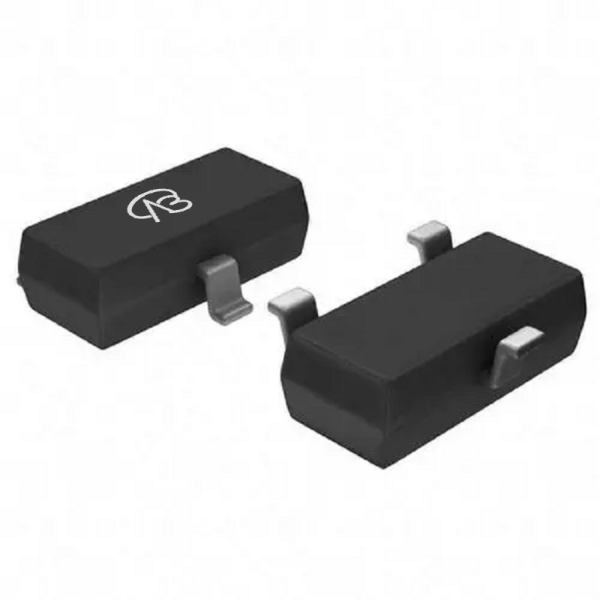
Comparative Analysis: NX6008NBKR (N-channel) vs. VB162K
Analysis of the Original Model (NX6008NBKR) Core:
This is a 60V N-channel MOSFET from Nexperia in a compact SOT23 (TO-236AB) package. Its design core is to provide reliable switching in space-constrained, low-current applications. Key features include a drain current of 270mA and an on-resistance (RDS(on)) of 2.8Ω at a 4.5V gate drive. It uses trench MOSFET technology for good performance in a tiny footprint.
Compatibility and Differences of the Domestic Alternative (VB162K):
VBsemi's VB162K is a pin-to-pin compatible alternative in an SOT23-3 package. The key differences are in electrical parameters: VB162K has a similar 60V voltage rating but a lower continuous drain current of 0.3A (300mA). Its on-resistance is higher at 3100mΩ (3.1Ω) @ 4.5V and 2800mΩ (2.8Ω) @ 10V.
Key Application Areas:
Original Model NX6008NBKR: Suitable for low-current signal switching, level shifting, or driving small loads in 60V systems where minimal board space is critical. Examples include:
Signal path switching in portable devices.
Load switching for sensors or LEDs in low-power circuits.
Interface protection circuits.
Alternative Model VB162K: A viable alternative for applications with similar voltage requirements but where the slightly lower current (300mA) and higher on-resistance are acceptable, primarily in ultra-low-power signal switching scenarios.
Comparative Analysis: PMV450ENEAR (N-channel) vs. VB1695
This comparison shifts to N-channel MOSFETs designed for higher current handling within the same small SOT23 footprint, focusing on a better balance of current and on-resistance.
Analysis of the Original Model (PMV450ENEAR) Core:
This Nexperia MOSFET is also in an SOT23 package but is engineered for more demanding low-power applications. Its core advantages are:
Higher Current Capability: A continuous drain current of 800mA.
Lower On-Resistance: RDS(on) of 380mΩ at 10V gate drive, enabling lower conduction losses.
Compact Power Switching: Provides a good power-density solution in a miniature package.
Compatibility and Differences of the Domestic Alternative (VB1695):
VBsemi's VB1695 represents a significant "performance-enhanced" alternative. It is pin-to-pin compatible (SOT23-3) but offers substantially improved key parameters:
Much Higher Current: A continuous drain current of 4A.
Dramatically Lower On-Resistance: RDS(on) of 86mΩ @ 4.5V and 75mΩ @ 10V.
Same Voltage Rating: 60V.
Key Application Areas:
Original Model PMV450ENEAR: Ideal for applications requiring higher current than basic signal MOSFETs but still constrained by the SOT23 footprint. Typical uses include:
Power management switches in compact modules.
Driving higher-current LEDs or small relays.
Load switches in battery-powered devices needing up to 800mA.
Alternative Model VB1695: Suited for upgraded scenarios demanding much higher current handling and significantly lower conduction losses in the same package size. It opens possibilities for:
More efficient DC-DC converter switches in tight spaces.
Driving motors or loads requiring several amps.
Replacing heftier MOSFETs to save board space while maintaining performance.
Conclusion:
This analysis reveals two distinct selection paths for small-signal and power switching:
For basic low-current signal switching (sub-300mA), the original NX6008NBKR offers a proven solution. Its domestic alternative VB162K provides a compatible option with slightly different parameters for cost-sensitive designs.
For higher-current switching in a miniaturized footprint, the original PMV450ENEAR delivers a solid 800mA capability. However, the domestic alternative VB1695 stands out as a high-performance upgrade, offering a dramatic increase in current (4A) and a drastic reduction in on-resistance, enabling higher efficiency and power density in the same SOT23 space.
The core takeaway is precise requirement matching. Domestic alternatives like VB1695 demonstrate that they can offer not just compatibility but also substantial performance gains, providing engineers with greater flexibility and resilience in component selection for modern, space-constrained designs.

Download PDF document
 Download now


