 中文
中文 English
MOSFET Selection for High-Frequency Power Conversion: IRLR7821TRLPBF, IPD180N10N3GATMA1 vs. China Alternatives VBE1310, VBE1102N
Number of views:9999
 Back to previous page
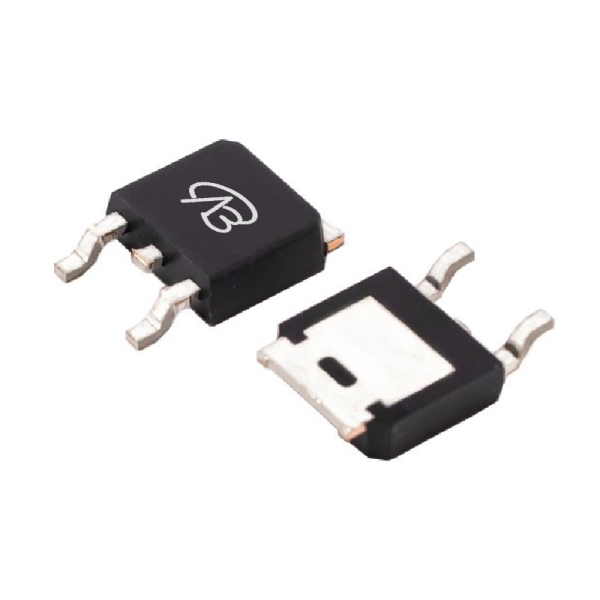
Comparative Analysis: IRLR7821TRLPBF (N-channel) vs. VBE1310
Analysis of the Original Model (IRLR7821TRLPBF) Core:
This is a 30V N-channel MOSFET from Infineon in a DPAK (TO-252AA) package. Its design core focuses on achieving extremely low conduction resistance and high-frequency switching capability for synchronous buck converters. Key advantages include: a very low on-resistance of 7.5mΩ at a 10V gate drive, a high continuous drain current of 65A, and a power dissipation rating of 75W. It features ultra-low gate charge, enabling high-frequency operation with minimal driving losses.
Compatibility and Differences of the Domestic Alternative (VBE1310):
VBsemi's VBE1310 is a direct pin-to-pin compatible alternative in the same TO-252 package. The key differences are in the electrical parameters: VBE1310 offers a comparable voltage rating (30V) and a slightly lower on-resistance of 7mΩ at 10V. Its continuous current rating is 70A, which is marginally higher than the original's 65A. This makes it a strong performance-equivalent or slightly enhanced alternative.
Key Application Areas:
Original Model IRLR7821TRLPBF: Ideal for high-frequency synchronous rectification in low-voltage, high-current scenarios. Typical applications include:
High-frequency synchronous buck converters for computer processor power supplies.
Synchronous rectification in isolated DC-DC converters for telecom and industrial use.
Alternative Model VBE1310: Suited for the same high-frequency switching applications, offering a potential margin for lower conduction loss and slightly higher current handling, making it a viable replacement in 30V systems.
Comparative Analysis: IPD180N10N3GATMA1 (N-channel) vs. VBE1102N
Analysis of the Original Model (IPD180N10N3GATMA1) Core:
This 100V N-channel MOSFET from Infineon, also in a TO-252 package, is engineered for high-voltage applications requiring an excellent Figure of Merit (low gate charge x RDS(on)). Its core advantages are: a good balance of on-resistance (18mΩ @10V) and current capability (43A), a high operating junction temperature of 175°C, and optimization for high-frequency switching and synchronous rectification.
Compatibility and Differences of the Domestic Alternative (VBE1102N):
VBsemi's VBE1102N is a direct pin-to-pin compatible alternative. It matches the original's key parameters very closely: the same 100V voltage rating, an identical on-resistance of 18mΩ at 10V, and a slightly higher continuous current rating of 45A (vs. 43A). This makes it a highly equivalent drop-in replacement.
Key Application Areas:
Original Model IPD180N10N3GATMA1: Excellent for high-voltage, medium-current applications demanding high efficiency and frequency. Typical uses include:
High-frequency switching power supplies (e.g., SMPS).
Synchronous rectification in 48V-100V DC-DC converters.
Motor drives and industrial controls.
Alternative Model VBE1102N: Perfectly suited for the same application spaces—high-frequency switching and synchronous rectification in 100V systems—offering equivalent electrical performance and enhanced supply chain flexibility.
Conclusion:
This comparative analysis reveals two clear selection paths:
For high-frequency, low-voltage (30V) synchronous conversion, the original IRLR7821TRLPBF sets a high standard with its 7.5mΩ on-resistance and 65A current capability. Its domestic alternative VBE1310 offers a compelling, performance-comparable option with slightly better on-resistance (7mΩ) and current rating (70A), serving as an excellent substitute in applications like CPU VRMs and telecom DC-DC converters.
For high-voltage (100V) applications prioritizing switching FOM, the original IPD180N10N3GATMA1 provides a reliable solution with 18mΩ RDS(on) and 43A current. The domestic alternative VBE1102N emerges as a near-identical equivalent, matching the on-resistance and offering a slightly higher 45A current, making it a robust and reliable alternative for high-frequency power supplies and motor drives.
The core conclusion is that selection hinges on precise requirement matching. In the context of supply chain diversification, domestic alternatives like VBE1310 and VBE1102N not only provide viable, performance-equivalent backups but also offer engineers greater flexibility and resilience in design trade-offs and cost control. Understanding each device's parameter profile is key to leveraging its full value in the circuit.

Download PDF document
 Download now


