 中文
中文 English
MOSFET Selection for Signal Switching vs. High-Current Power: 2N7002BK,215, PSMN2R0-30YLE,115 vs. China Alternatives VB162K, VBED1303
Number of views:9999
 Back to previous page
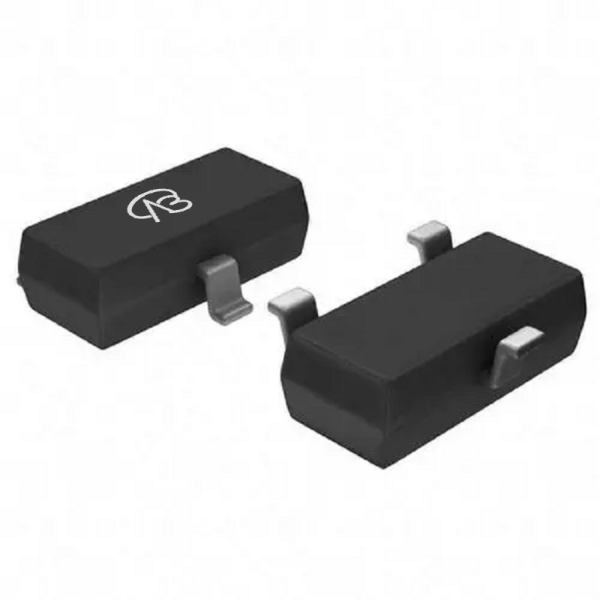
Comparative Analysis: 2N7002BK,215 (Small-Signal N-Channel) vs. VB162K
Analysis of the Original Model (2N7002BK,215) Core:
This is a 60V N-channel small-signal MOSFET from Nexperia in a compact SOT-23 package. Its design core is to provide reliable voltage switching and signal interfacing in space-constrained, low-current circuits. Key advantages include a standard 60V drain-source voltage rating, a continuous drain current of 350mA, and an on-resistance of 1.6Ω at 10V gate drive. It is a classic choice for logic-level switching and signal isolation.
Compatibility and Differences of the Domestic Alternative (VB162K):
VBsemi's VB162K is offered in the same SOT23-3 package and serves as a functional pin-to-pin compatible alternative. The key parameters are closely matched: both are 60V N-channel trench MOSFETs. The main differences lie in the current rating and on-resistance: VB162K has a slightly lower continuous current rating of 0.3A (300mA) compared to the original's 350mA, and its on-resistance is higher at 2.8Ω (@10V) versus 1.6Ω. This makes the original model marginally better for applications requiring the absolute lowest voltage drop or highest current in its class.
Key Application Areas:
Original Model 2N7002BK,215: Ideal for general-purpose low-side switching, signal level translation, and load switching in low-power digital circuits. Common uses include:
GPIO interfacing and signal isolation in microcontrollers.
Driving small relays, LEDs, or other low-current peripherals.
Protection circuits and load switches in consumer electronics.
Alternative Model VB162K: A suitable domestic alternative for most applications where the original 2N7002 is used, particularly when the current demand is reliably under 300mA and a slightly higher conduction loss is acceptable. It provides a solid backup option for logic-level switching and signal control.
Comparative Analysis: PSMN2R0-30YLE,115 (Power N-Channel) vs. VBED1303
This comparison shifts from small-signal to high-power switching. The design pursuit for the original model is maximizing current handling and minimizing conduction loss in a thermally efficient package.
Analysis of the Original Model (PSMN2R0-30YLE,115) Core:
This is a 30V N-channel power MOSFET from Nexperia in an SOT-669 (LFPAK) package, optimized for low voltage, high current applications. Its core advantages are:
Exceptional Current Capability: A very high continuous drain current rating of 100A.
Extremely Low On-Resistance: An ultra-low RDS(on) of 2.0mΩ at 10V gate drive, minimizing conduction losses.
Power-Optimized Package: The SOT-669 package offers excellent thermal performance for its size, essential for high-current applications.
Compatibility and Differences of the Domestic Alternative (VBED1303):
VBsemi's VBED1303 is a direct competitor in the same SOT-669 package. It matches the original's 30V voltage rating and offers compelling, even enhanced, performance in key areas:
Similar High Current Rating: A robust 90A continuous current, suitable for most high-current applications.
Comparable Low On-Resistance: An impressively low RDS(on) of 2.8mΩ at 10V, which is very close to the original's 2.0mΩ.
Logic-Level Drive Friendly: It also features a low gate threshold voltage, making it suitable for drive by 5V or lower microcontroller signals.
Key Application Areas:
Original Model PSMN2R0-30YLE,115: The benchmark for high-efficiency, high-current switching in compact spaces. Typical applications include:
Synchronous rectification in low-voltage, high-current DC-DC converters (e.g., for CPUs, GPUs, POL converters).
Motor drive and control in power tools, drones, and automotive systems.
High-current load switches and battery management system (BMS) protection circuits.
Alternative Model VBED1303: A powerful domestic alternative that delivers near-identical performance for high-current applications. With its 90A rating and 2.8mΩ RDS(on), it is an excellent choice for upgrading designs or as a reliable alternative for DC-DC conversion, motor drives, and primary power switching where high efficiency and thermal performance are critical.
Conclusion:
This analysis reveals two distinct selection paradigms:
For small-signal switching and logic interfacing, the original 2N7002BK,215 remains a classic, high-reliability choice with its 350mA current and 1.6Ω on-resistance. Its domestic alternative VB162K provides a functionally compatible solution for cost-sensitive or supply-chain diversified designs where the slight parameter differences are acceptable.
For high-current, low-voltage power switching, the original PSMN2R0-30YLE,115 sets a high standard with its 100A current and 2.0mΩ RDS(on). The domestic alternative VBED1303 emerges as a highly competitive counterpart, offering 90A current and 2.8mΩ RDS(on) in the same package, making it a strong candidate for performance-driven applications requiring supply chain resilience.
The core takeaway is that selection is driven by application demands. Domestic alternatives like VB162K and VBED1303 not only provide viable backup options but also demonstrate competitive performance, offering engineers greater flexibility in design optimization and cost management. Understanding the specific requirements of your circuit—whether it's milliamps for signal control or tens of amps for power delivery—is key to selecting the most appropriate MOSFET.

Download PDF document
 Download now


