 中文
中文 English
MOSFET Selection for High-Voltage and Medium-Power Applications: IPD95R2K0P7ATMA1, IRF9530NPBF vs. China Alternatives VBE19R02S, VBM2102M
Number of views:9999
 Back to previous page
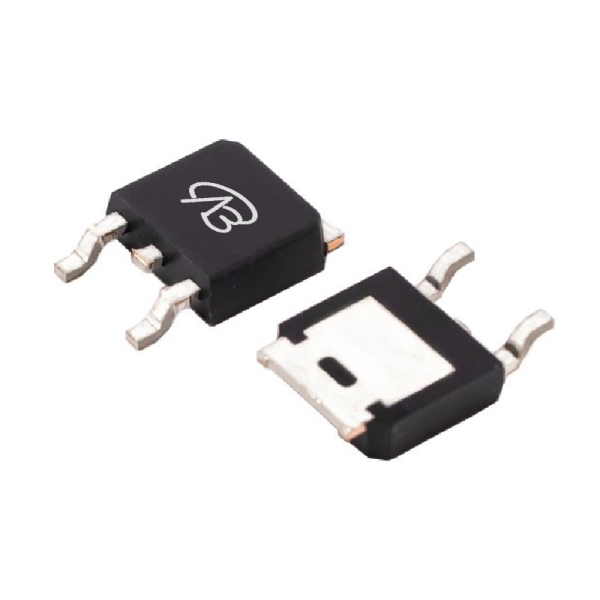
Comparative Analysis: IPD95R2K0P7ATMA1 (N-channel) vs. VBE19R02S
Analysis of the Original Model (IPD95R2K0P7ATMA1) Core:
This is a 950V N-channel MOSFET from Infineon in a TO-252 (DPAK) package. Its design core focuses on achieving an excellent figure of merit (RDS(on) Eoss) for high-voltage, low-power applications. Key advantages include: a high voltage rating of 950V, a continuous drain current of 4A, and an optimized gate threshold voltage (VGS(th)) of 3V with minimal variation (±0.5V). It features integrated Zener diode for ESD protection and is renowned for best-in-class quality and reliability in its package class.
Compatibility and Differences of the Domestic Alternative (VBE19R02S):
VBsemi's VBE19R02S is also offered in a TO-252 package and serves as a pin-to-pin compatible alternative. The main differences lie in the electrical parameters: VBE19R02S has a slightly lower voltage rating (900V) and a higher on-resistance (2700mΩ @10V vs. 2000mΩ @10V for the original). Its continuous current rating is also lower at 2A.
Key Application Areas:
Original Model IPD95R2K0P7ATMA1: Its high voltage rating and optimized switching characteristics make it ideal for high-voltage, low-to-medium power applications where efficiency and reliability are paramount. Typical uses include:
Flyback converters for LED lighting and low-power adapters/chargers.
Auxiliary and industrial power supplies.
PFC stages in consumer and solar applications.
Smart meter power modules.
Alternative Model VBE19R02S: More suitable for applications where a 900V rating is sufficient and the current demand is lower (within 2A), offering a cost-effective alternative for basic high-voltage switching needs.
Comparative Analysis: IRF9530NPBF (P-channel) vs. VBM2102M
This P-channel MOSFET is designed for medium-power applications requiring a simple drive solution (due to its P-channel nature) and good conduction performance.
Analysis of the Original Model (IRF9530NPBF) Core:
This -100V P-channel MOSFET from Infineon uses a TO-220AB package. Its core advantages are:
Robust Conduction: With a continuous drain current of -14A and an on-resistance of 200mΩ @ -10V, it offers solid performance for medium-current paths.
Standard Package: The TO-220AB provides good thermal performance for its power level, suitable for various power management tasks.
The domestic alternative VBM2102M presents a "performance-enhanced" option: It matches the -100V voltage rating but offers significantly better conduction parameters: a higher continuous current of -18A and a substantially lower on-resistance of 167mΩ @ -10V. This translates to lower conduction losses and higher current-handling capability in similar applications.
Key Application Areas:
Original Model IRF9530NPBF: A reliable choice for standard P-channel applications such as:
High-side switching in DC-DC converters.
Load switching and power management in 12V-48V systems.
Motor control and polarity protection circuits.
Alternative Model VBM2102M: Better suited for upgraded scenarios demanding lower voltage drop and higher current capacity, such as more efficient high-side switches or higher-power motor drives within the same voltage range.
Summary
This comparative analysis reveals two distinct selection paths:
For high-voltage N-channel applications like flyback converters, the original model IPD95R2K0P7ATMA1, with its 950V rating, optimized switching figure of merit, and integrated protection, remains a top-tier choice for designs prioritizing reliability and efficiency in demanding environments. Its domestic alternative VBE19R02S provides a compatible, cost-effective option for applications where the slightly lower voltage (900V) and current (2A) ratings are acceptable.
For medium-power P-channel applications requiring high-side switching, the original model IRF9530NPBF offers proven performance with its -100V/-14A rating. The domestic alternative VBM2102M emerges as a compelling "performance-enhanced" substitute, delivering lower on-resistance and higher current capability (-18A), making it ideal for designs seeking to reduce losses or increase power density.
The core conclusion is: Selection is not about absolute superiority but precise requirement matching. In the context of supply chain diversification, domestic alternatives like VBE19R02S and VBM2102M not only provide viable backup options but also offer opportunities for cost savings or specific parameter improvements, giving engineers greater flexibility in design trade-offs. Understanding the design philosophy and parameter implications of each device is key to maximizing its value in the circuit.

Download PDF document
 Download now


