 中文
中文 English
MOSFET Selection for Medium-Power Applications: DMT15H053SK3-13, ZXMP10A17GQTA vs. China Alternatives VBE1154N, VBJ2102M
Number of views:9999
 Back to previous page
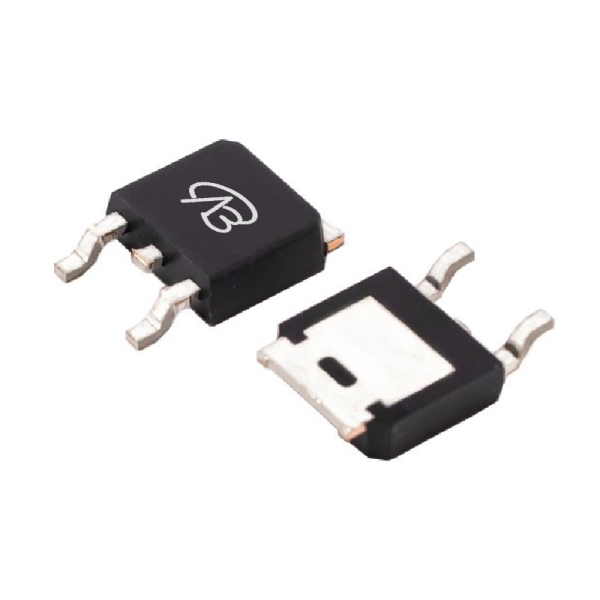
Comparative Analysis: DMT15H053SK3-13 (N-channel) vs. VBE1154N
Analysis of the Original Model (DMT15H053SK3-13) Core:
This is a 150V N-channel MOSFET from DIODES in a TO-252 (DPAK) package. It is engineered for medium-power applications requiring high voltage endurance and good current capability. Its key strengths include a continuous drain current of 21A and a drain-source voltage rating of 150V. The on-resistance is 60mΩ at a 10V gate drive, and it supports a power dissipation of 60W, making it suitable for circuits where thermal management is feasible.
Compatibility and Differences of the Domestic Alternative (VBE1154N):
VBsemi's VBE1154N is a direct pin-to-pin compatible alternative in the same TO-252 package. It offers significant performance enhancements in key areas: a lower on-resistance of 32mΩ at 10V and a higher continuous current rating of 40A, while maintaining the same 150V voltage rating. This results in reduced conduction losses and improved efficiency in high-current paths.
Key Application Areas:
Original Model DMT15H053SK3-13: Ideal for 150V systems requiring reliable switching at currents up to 21A, such as AC-DC power supplies, motor drives, and industrial controls where its 60W power dissipation is adequate.
Alternative Model VBE1154N: Better suited for upgraded designs demanding higher efficiency and current capacity (up to 40A). Its lower RDS(on) makes it excellent for high-current switching in power converters, motor controllers, and applications where reducing thermal stress is a priority.
Comparative Analysis: ZXMP10A17GQTA (P-channel) vs. VBJ2102M
This comparison focuses on P-channel MOSFETs for lower-current, high-voltage switching in space-constrained designs.
Analysis of the Original Model (ZXMP10A17GQTA) Core:
This is a 100V P-channel MOSFET from DIODES in a compact SOT-223-3 package. It is designed for applications where board space is limited but a high voltage rating is needed. It features a continuous drain current of -2.4A, a drain-source voltage of -100V, and an on-resistance of 350mΩ at a -10V gate drive.
Compatibility and Differences of the Domestic Alternative (VBJ2102M):
VBsemi's VBJ2102M is a pin-to-pin compatible alternative in the SOT-223 package. It provides improved conduction performance with a lower on-resistance of 200mΩ at -10V (and 230mΩ at -4.5V) and a higher continuous current rating of -3A, while maintaining the same -100V voltage rating.
Key Application Areas:
Original Model ZXMP10A17GQTA: Suitable for compact 100V circuits with moderate current needs (around 2.4A), such as load switching, power management in communication modules, or high-side switching in low-power systems.
Alternative Model VBJ2102M: A superior choice for applications requiring lower conduction loss and higher current handling (up to 3A) within the same compact footprint. It is ideal for efficient power path management, battery protection circuits, and space-constrained DC-DC converters in 100V systems.
Conclusion
This analysis reveals two distinct upgrade paths:
For 150V N-channel applications, the domestic alternative VBE1154N offers a substantial performance boost over the DMT15H053SK3-13, with significantly lower on-resistance and higher current capability, enabling more efficient and powerful designs.
For 100V P-channel applications in compact packages, the alternative VBJ2102M outperforms the ZXMP10A17GQTA with better conduction characteristics and current rating, providing an efficiency enhancement in space-limited layouts.
The core takeaway is that selection depends on precise requirement matching. These domestic alternatives not only serve as reliable backups but also offer performance advantages, giving engineers greater flexibility in optimizing their designs for cost, efficiency, and supply chain resilience. Understanding each device's parameter profile is key to leveraging its full potential in the circuit.

Download PDF document
 Download now


