 中文
中文 English
MOSFET Selection for Compact Power Applications: DMN52D0UV-13, DMT10H025LK3-13 vs. China Alternatives VBTA3615M, VBE1102N
Number of views:9999
 Back to previous page
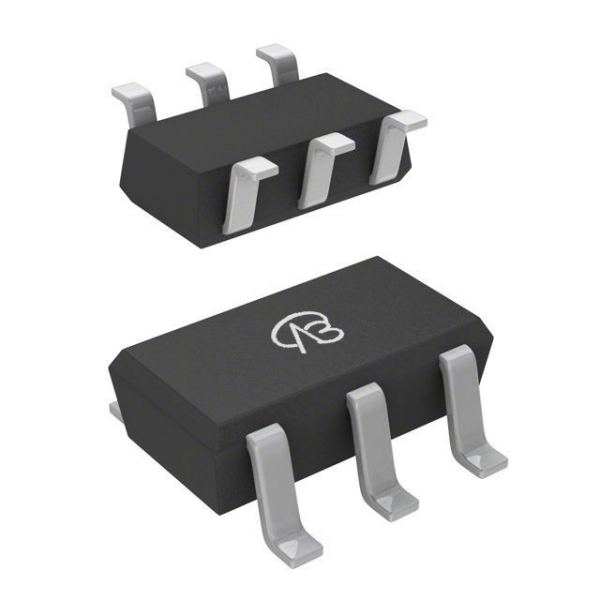
Comparative Analysis: DMN52D0UV-13 (N-channel) vs. VBTA3615M
Analysis of the Original Model (DMN52D0UV-13) Core:
This is a 50V N-channel MOSFET from DIODES, using an ultra-compact SOT-563 package. Its design core is to provide reliable signal-level switching and power management in a minimal footprint. The key advantages are: a low threshold voltage suitable for 1.8V gate drive, an on-resistance of 4Ω at 1.8V, and a continuous drain current of 480mA. Its low power dissipation (890mW) makes it ideal for space-constrained, low-power applications.
Compatibility and Differences of the Domestic Alternative (VBTA3615M):
VBsemi's VBTA3615M uses a small SC75-6 package and is a dual N+N channel MOSFET. The main differences lie in the electrical parameters and configuration: VBTA3615M has a higher voltage rating (60V) and lower on-resistance (1.5Ω @4.5V, 1.2Ω @10V), but a lower continuous current per channel (0.3A). It offers the functionality of two N-channel devices in one package.
Key Application Areas:
Original Model DMN52D0UV-13: Its characteristics are very suitable for low-current switching, signal isolation, or load management in portable electronics, IoT sensors, and battery-powered devices where board space is extremely limited.
Alternative Model VBTA3615M: More suitable for applications requiring dual N-channel switches with higher voltage tolerance and lower on-resistance, but where the current demand per channel is low (within 0.3A), such as in specific analog switching or power management circuits needing channel redundancy or independent control.
Comparative Analysis: DMT10H025LK3-13 (N-channel) vs. VBE1102N
Unlike the low-power model focusing on miniaturization, the design pursuit of this N-channel MOSFET is 'high current and low loss' for robust power management.
The core advantages of the original model are reflected in three aspects:
Excellent conduction performance: With a 100V drain-source voltage rating, it supports a high continuous current of 47.2A and features a low on-resistance of 17.1mΩ at 10V gate drive. This minimizes conduction losses in high-current paths.
Fast switching characteristics: As a next-generation MOSFET, it is designed for fast switching, which is crucial for high-frequency power conversion efficiency.
Robust power package: Using the TO-252 (DPAK) package, it provides good thermal performance for handling significant power dissipation in medium-to-high power applications.
The domestic alternative VBE1102N is a highly competitive direct alternative: It matches or closely matches key parameters: the same 100V voltage rating, a slightly higher continuous current of 45A, and a comparable on-resistance of 18mΩ (@10V). This makes it a viable pin-to-pin compatible replacement in most applications.
Key Application Areas:
Original Model DMT10H025LK3-13: Its high current capability and low on-resistance make it an ideal choice for high-efficiency power management applications. For example: Synchronous rectification in 48V/60V DC-DC converters, motor drives for e-bikes or tools, and high-current load switches in telecom/server power supplies.
Alternative Model VBE1102N: Is equally suitable for the same high-power applications—such as DC-DC converters, motor drives, and power distribution systems—offering a reliable domestic alternative with minimal design adjustment.
In summary, this comparative analysis reveals two clear selection paths:
For ultra-compact, low-power N-channel applications, the original model DMN52D0UV-13, with its tiny SOT-563 package and optimized parameters for low-voltage drive, is a strong candidate for space-critical designs. Its domestic alternative VBTA3615M offers a dual N-channel solution in a small package with higher voltage rating and lower RDS(on), suitable for designs needing two switches where current per channel is under 0.3A.
For high-current, high-voltage N-channel applications, both the original model DMT10H025LK3-13 and the domestic alternative VBE1102N present highly similar performance profiles. The original model holds a slight edge in current rating (47.2A vs. 45A), while VBE1102N provides a nearly equivalent, readily available alternative, ensuring design continuity and supply chain resilience.
The core conclusion is: There is no absolute superiority or inferiority in selection; the key lies in precise matching of requirements. In the context of supply chain diversification, domestic alternative models not only provide feasible backup options but also offer specific advantages (like dual channels or package options), giving engineers more flexible and resilient choice space in design trade-offs and cost control. Understanding the design philosophy and parameter implications of each device is essential to maximize its value in the circuit.

Download PDF document
 Download now


