 中文
中文 English
MOSFET Selection for Compact Signal & Power Switching: BSS138K-7, DMN2075U-7 vs. China Alternatives VB162K, VB1240
Number of views:9999
 Back to previous page
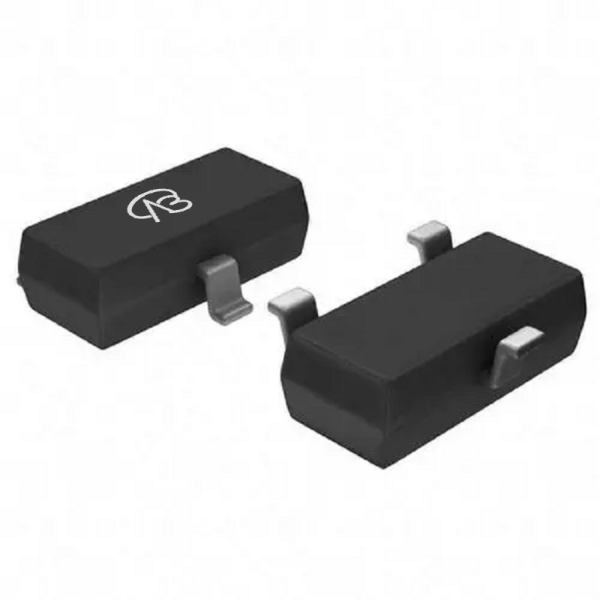
Comparative Analysis: BSS138K-7 (N-channel) vs. VB162K
Analysis of the Original Model (BSS138K-7) Core:
This is a 50V N-channel MOSFET from DIODES in a compact SOT-23 package. Its design core is to minimize on-resistance (RDS(ON)) while maintaining excellent switching performance, making it ideal for efficient power management applications. Key parameters include a continuous drain current (Id) of 200mA and an on-resistance of 3.5Ω @ 10V, 0.22A. With a power dissipation (Pd) of 300mW, it offers a reliable solution for low-power switching.
Compatibility and Differences of the Domestic Alternative (VB162K):
VBsemi's VB162K is also housed in an SOT23-3 package, offering direct pin-to-pin compatibility. The key differences are in the electrical parameters: VB162K has a higher voltage rating (60V vs. 50V) and a significantly lower on-resistance (2.8Ω @ 10V vs. 3.5Ω @ 10V). However, its continuous drain current rating is slightly higher at 0.3A compared to the original's 200mA.
Key Application Areas:
Original Model BSS138K-7: Perfect for applications requiring a 50V rating with low current switching, such as:
Load switching and level shifting in low-power digital circuits.
Protection circuits and signal isolation.
Power management in portable devices and IoT sensors.
Alternative Model VB162K: Suitable for similar applications as the BSS138K-7 but where a higher voltage margin (60V) and slightly lower on-resistance are beneficial, offering a robust alternative for signal switching and low-power control.
Comparative Analysis: DMN2075U-7 (N-channel) vs. VB1240
This comparison focuses on N-channel MOSFETs designed for higher current handling in a small SOT-23 package, where the balance between low on-resistance and fast switching is critical.
Analysis of the Original Model (DMN2075U-7) Core:
This 20V N-channel MOSFET from DIODES is designed for performance in a miniaturized footprint. Its core advantages are:
Low On-Resistance: Very low RDS(on) of 25mΩ @ 4.5V, 3.6A, minimizing conduction losses.
Good Current Handling: Continuous drain current (Id) of 1.2A.
Fast Switching & Low Capacitance: Features low input capacitance and fast switching speed, essential for efficient power conversion.
High Reliability: It is a fully RoHS-compliant, halogen-free, and antimony-free green device, meeting high-reliability standards.
Compatibility and Differences of the Domestic Alternative (VB1240):
VBsemi's VB1240 is a direct pin-to-pin compatible alternative in an SOT23-3 package. It represents a significant "performance-enhanced" choice:
Superior Current Capability: A much higher continuous drain current of 6A compared to the original's 1.2A.
Lower On-Resistance: Achieves an ultra-low RDS(on) of 28mΩ @ 4.5V (vs. 25mΩ @ 4.5V for the original, under different test conditions), further reducing power loss.
Similar Voltage Rating: Maintains the same 20V drain-source voltage rating.
Key Application Areas:
Original Model DMN2075U-7: An excellent choice for space-constrained applications requiring efficient switching for currents up to 1.2A. Typical uses include:
Power management in portable devices (load switches, DC-DC converter switches).
Driver circuits for small motors or solenoids.
Battery protection circuits and power distribution.
Alternative Model VB1240: Ideal for upgraded scenarios demanding significantly higher current handling (up to 6A) and lower conduction losses in the same footprint. Suitable for:
More demanding load switches and power path management.
Higher-current DC-DC conversion stages.
Driving larger peripherals where the original model's current rating is limiting.
Conclusion
This analysis reveals two distinct selection pathways for small-package MOSFETs:
For low-power signal and switching applications around 50V, the original BSS138K-7 provides a reliable, industry-standard solution. Its domestic alternative, VB162K, offers a compatible package with a higher voltage rating and competitive on-resistance, serving as a viable alternative or upgrade for designs needing extra voltage headroom.
For higher-current switching applications within a 20V range, the original DMN2075U-7 strikes an excellent balance between low RDS(on), switching speed, and compact size. Its domestic alternative, VB1240, delivers dramatic "performance enhancement" with a 5x increase in current rating and very low on-resistance, making it a powerful upgrade for designs pushing the limits of power density in a SOT-23 footprint.
The core takeaway is that selection is about precise requirement matching. In the context of supply chain diversification, domestic alternatives like VB162K and VB1240 not only provide reliable backup options but can also offer superior performance in key parameters, giving engineers greater flexibility and resilience in design trade-offs and cost optimization. Understanding the specific design philosophy and parameter implications of each device is key to unlocking its full potential in your circuit.

Download PDF document
 Download now


