 中文
中文 English
MOSFET Selection for High-Current Power Applications: AOD508, AOD424 vs. China Alternatives VBE1303, VBE1206
Number of views:9999
 Back to previous page
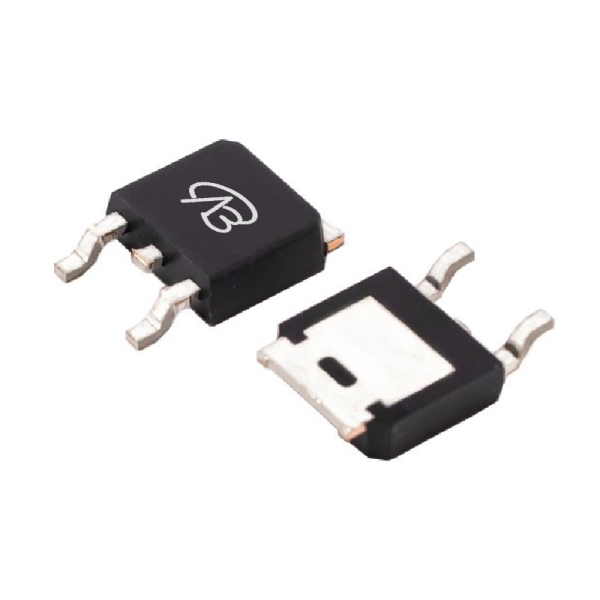
Comparative Analysis: AOD508 (N-channel) vs. VBE1303
Analysis of the Original Model (AOD508) Core:
This is a 30V N-channel MOSFET from AOS in a TO-252 (DPAK) package. Its design core is to deliver very high continuous current (70A) with low conduction loss in a compact industry-standard package. Key advantages include: an extremely low on-resistance of 3mΩ at a 10V gate drive, enabling high efficiency under heavy loads. Its high current rating makes it suitable for demanding power path and switching applications.
Compatibility and Differences of the Domestic Alternative (VBE1303):
VBsemi's VBE1303 is a direct pin-to-pin compatible alternative in the same TO-252 package. The key differences are in the electrical parameters: VBE1303 offers a similar voltage rating (30V) but significantly higher continuous drain current (100A). Furthermore, it achieves a lower on-resistance of 2mΩ at 10V gate drive, indicating potentially lower conduction losses and better thermal performance under high current compared to the original AOD508.
Key Application Areas:
Original Model AOD508: Ideal for high-current, medium-voltage applications where low RDS(on) in a standard package is critical. Typical uses include:
High-current DC-DC converters and voltage regulators.
Power switches in motor drives and solenoid controls.
Load switches and power distribution in servers, telecom, and industrial equipment.
Alternative Model VBE1303: Suited for the same applications as AOD508 but offers a performance upgrade for designs requiring even higher current capability (up to 100A) and lower conduction loss (2mΩ). It is an excellent choice for next-generation designs or for enhancing the power margin and efficiency of existing circuits.
Comparative Analysis: AOD424 (N-channel) vs. VBE1206
This comparison focuses on N-channel MOSFETs optimized for slightly lower voltage but still high-current applications, where efficiency at moderate gate drive is essential.
Analysis of the Original Model (AOD424) Core:
The AOD424 from AOS is a 20V N-channel MOSFET in a TO-252 package. Its design pursues a balance of high current (45A) and low on-resistance (4.4mΩ at 4.5V Vgs) suitable for systems like 12V rails. It provides robust performance in a cost-effective, widely adopted package.
Compatibility and Differences of the Domestic Alternative (VBE1206):
VBsemi's VBE1206 is a direct pin-to-pin alternative. It matches the 20V voltage rating but dramatically increases the continuous current rating to 100A. Its on-resistance is also competitive at 4.5mΩ (at 4.5V Vgs), similar to the original, but it maintains this performance for a much higher current range. This makes it a substantially more robust alternative in terms of current handling.
Key Application Areas:
Original Model AOD424: Well-suited for applications on 12V power buses requiring efficient switching and high current, such as:
Synchronous rectification in intermediate DC-DC stages.
Motor drives for fans, pumps, or small automotive accessories.
General-purpose high-side or low-side switching in power management.
Alternative Model VBE1206: Targets the same application spaces as AOD424 but is particularly advantageous for designs demanding higher power density, greater current headroom (up to 100A), and improved reliability under stress. It is a strong candidate for upgrading existing platforms or designing new systems with enhanced durability.
Conclusion
In summary, this analysis reveals two distinct selection pathways for high-current applications:
For 30V-level N-channel applications, the original AOD508 offers excellent performance with 70A current and 3mΩ RDS(on). Its domestic alternative, VBE1303, provides a significant performance-enhanced option with higher current (100A) and lower on-resistance (2mΩ), making it ideal for pushing efficiency and power density limits in next-generation designs.
For 20V-level N-channel applications, the AOD424 is a reliable choice with 45A current and 4.4mΩ RDS(on). Its domestic alternative, VBE1206, emerges as a robust upgrade, matching the on-resistance while offering a vastly higher current rating (100A), providing substantial margin and increased reliability for demanding high-current circuits.
The core takeaway is that selection is about precise requirement matching. In the context of supply chain diversification, these domestic alternatives (VBE1303, VBE1206) not only serve as viable backups but also offer superior parameters in key areas, giving engineers greater flexibility and resilience in design trade-offs and cost optimization. Understanding the design philosophy and parameter implications of each device is essential to unlocking its full potential in your circuit.

Download PDF document
 Download now


