 中文
中文 English
MOSFET Selection for High-Power & High-Voltage Applications: AOB66920L, AOT380A60L vs. China Alternatives VBL1105, VBM16R11S
Number of views:9999
 Back to previous page
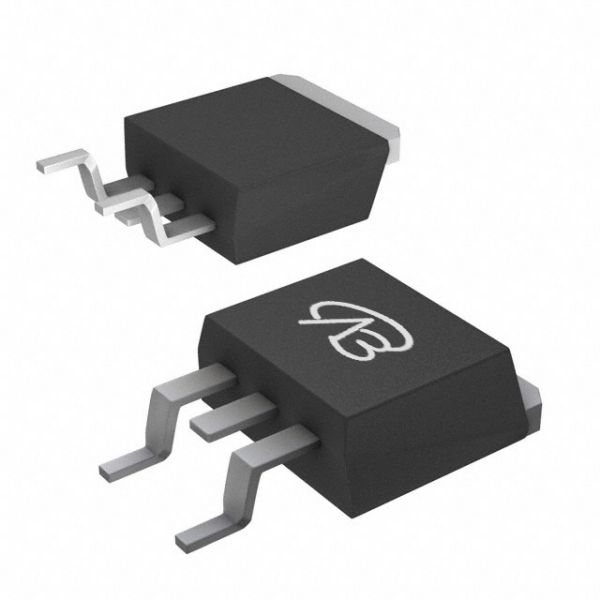
Comparative Analysis: AOB66920L (N-channel) vs. VBL1105
Analysis of the Original Model (AOB66920L) Core:
This is a 100V N-channel MOSFET from AOS, packaged in the TO-263 (D2PAK). Its design core is to deliver high-current capability and low conduction loss in a standard power package. Key advantages include: a low on-resistance of 8mΩ at a 10V gate drive, and a high continuous drain current rating of 80A (note: 22.5A is often cited at specific thermal conditions, with 80A being the absolute maximum rating at Tc). This makes it suitable for applications demanding high power density and efficient thermal performance from its package.
Compatibility and Differences of the Domestic Alternative (VBL1105):
VBsemi's VBL1105 is a direct pin-to-pin compatible alternative in the same TO-263 package. The key differences are in the electrical parameters: VBL1105 offers a significantly lower on-resistance of 4mΩ (at 10V) and a higher continuous current rating of 140A, while maintaining the same 100V drain-source voltage rating. This represents a substantial performance enhancement in conduction characteristics.
Key Application Areas:
Original Model AOB66920L: Its balance of 100V rating, 80A current capability, and 8mΩ RDS(on) makes it well-suited for high-current, medium-voltage applications.
High-Current DC-DC Converters: Serving as the main switch or synchronous rectifier in 48V input bus converters or high-power POL (Point-of-Load) modules.
Motor Drives and Solenoid Control: Ideal for driving brushed/brushless DC motors or controlling actuators in industrial automation, robotics, or automotive systems.
Power Distribution & Switching: Used in hot-swap circuits, OR-ing controllers, and load switches for servers, telecom, and networking equipment.
Alternative Model VBL1105: With its ultra-low 4mΩ RDS(on) and 140A current rating, it is an excellent choice for performance-upgraded scenarios where minimizing conduction loss and maximizing current throughput are critical, such as in next-generation, higher-efficiency power supplies or more powerful motor drives within the same 100V range.
Comparative Analysis: AOT380A60L (N-channel) vs. VBM16R11S
This comparison shifts focus to high-voltage applications, where the design pursuit is a reliable balance of high voltage blocking capability and manageable conduction loss.
Analysis of the Original Model (AOT380A60L) Core:
This 600V N-channel MOSFET from AOS uses the classic TO-220 package. Its core advantages are:
High Voltage Capability: A 600V Vdss rating makes it suitable for off-line or high-voltage bus applications.
Balanced Performance: With an on-resistance of 380mΩ at 10V and a continuous current of 11A, it offers a practical compromise for its voltage class.
Proven Package: The TO-220 package provides good thermal dissipation for its power level, facilitating reliable operation in high-voltage environments.
Compatibility and Differences of the Domestic Alternative (VBM16R11S):
VBsemi's VBM16R11S is a highly compatible alternative in the TO-220 package. The parameters show a direct performance match: it offers the same 600V voltage rating, identical 380mΩ on-resistance (at 10V), and the same 11A continuous drain current. This makes it a true drop-in replacement from an electrical and form-factor perspective.
Key Application Areas:
Original Model AOT380A60L: Its 600V/11A rating with 380mΩ RDS(on) targets classic high-voltage, medium-power switch-mode applications.
Switch-Mode Power Supplies (SMPS): Used as the primary side switch in offline flyback, forward, or PFC (Power Factor Correction) stages for adapters, LED drivers, and industrial power supplies.
Light Motor Drives & Inverters: Suitable for driving fans, pumps, or as part of inverter circuits in appliances and light industrial equipment.
Alternative Model VBM16R11S: As a parameter-for-parameter equivalent, it is perfectly suited for the same application spaces as the original AOT380A60L. It provides a reliable domestic alternative for high-voltage power conversion and motor control, ensuring design continuity and supply chain diversification.
Conclusion
In summary, this comparative analysis reveals two distinct selection narratives:
For medium-voltage, high-current applications, the original AOB66920L, with its 8mΩ RDS(on) and 80A current capability, is a solid choice for power stages in 48-100V systems. Its domestic alternative, VBL1105, emerges as a compelling "performance-enhanced" option, offering significantly lower conduction loss (4mΩ) and higher current handling (140A) in the same package, enabling upgrades in efficiency and power density for demanding designs.
For high-voltage applications, the original AOT380A60L provides a reliable 600V/11A/380mΩ solution. Its domestic alternative, VBM16R11S, stands out as a "direct drop-in replacement", matching all key electrical parameters and package, offering a seamless path for supply chain resilience without any design compromise.
The core conclusion is that selection hinges on precise requirement matching. In the context of supply chain diversification, domestic alternatives not only provide viable backups but also offer opportunities for performance enhancement (as with VBL1105) or perfect functional equivalence (as with VBM16R11S). This gives engineers greater flexibility and resilience in design trade-offs and cost control. Understanding the design philosophy and parameter implications of each device is essential to maximize its value in the circuit.

Download PDF document
 Download now


